
Larimer County Previous Residents: Era Coverage
A house-history search changes with the date. Current tax tables, recorded instruments, historical directories, maps, census releases, and permit archives do not share one start year or one definition of a person connected with an address. This era table keeps those limits visible before a backward search begins.
| Source | Years it covers | Where held | What it shows |
|---|---|---|---|
| Assessor Account, Owner Location, and Sales | Current tax-year tables; TAXYEAR and RUNDATE identify the run | Larimer County Assessor public data | Parcel, situs, mailing fields, assessed name, sale and reception clues |
| Landmark Web recording index | 1971-present on Easy Access; guide says 1939-present; pre-1939 books in person | Clerk & Recorder Recording Division | Grantor, grantee, date, document type, legal description, reception and image status |
| Larimer land and archive series | County land records date to 1862; State Archives land 1867-1917 | Clerk & Recorder, State Archives, LCGS | Legal descriptions, land transfers, tax-sale and county record clues |
| Fort Collins city directories | 1902-present; no known city volumes 1941-1947; Street Guide gaps in 1904, 1906, 1907 | History Connection and LCGS | Names, addresses, people/business, rural and Street Guide clues |
| Loveland city directories | Most years from 1904-present | Loveland Public Library and Museum/Gallery | Former occupants, names, addresses and local history clues |
| Sanborn maps | Fort Collins printed 1886-1940; digital 1867-1970; Loveland dates through 1946 | Poudre Libraries, digital history, Loveland holdings | Building footprint, use, street orientation and dated structure context |
| Federal census | Through 1950 under the 72-year release rule | National Archives and library databases | Household composition at a census date, subject to address and enumeration limits |
| Permit and plan archives | Fort Collins Citizen Access May 2018-present; Weblink roughly 1930s-2018; older local repositories | County and municipal permit systems | Applicants, owners, contractors, plans, inspections and dated work records |
The table is a research map, not a promise that every year survives or every item is open. Begin with the current parcel, then choose the oldest source that can answer the question without stretching its purpose.
Larimer County Previous Residents from a Parcel
The current parcel is the anchor for previous residents research. Use Assessor Account and Owner Location fields to capture the parcel or account number, full situs components, short legal description, subdivision, assessed name, mailing location, tax year, and run date. Situs describes where the parcel is. Mailing describes where tax correspondence goes. Neither field is a household history.
The Assessor Sales table adds RECEPTIONNO, GRANTOR, GRANTEE, SALEPRICE, SALEDATE, DEEDCODE, and DEEDDESCRIPTION. That reception number is the bridge to a recorded instrument. GIS can confirm the parcel shape, subdivision, platted lot or block, and map location. The current address may be a poor key for an old record, but a parcel and legal description can lead to the older source.
Preserve the owner's name as an index value, not a final conclusion. A recorded owner, a permit applicant, a directory entry, and a person who lived in a dwelling may be different people. For the current address chain, use the Larimer County by-street record crosswalk after preserving the parcel and situs fields. A careful Larimer County previous residents trail keeps those roles separate from the first step.
Larimer County Deed Trail for Past Owners
Landmark Web is the route from a parcel clue to a recorded instrument. Use the Larimer County Clerk & Recorder index after the Assessor supplies a name, reception number, subdivision, lot, block, or legal description. The Recorder's search modes include Name, Legal, Advanced Legal, Reception Number, Book and Page, Document Type, and Record Date.
- Pull the current parcel record. Save the Assessor legal description, parcel or account number, Owner Location fields, Sales reception number, and tax run date.
- Test the current transfer. Search Landmark Web by reception number, legal description, or the indexed grantee name. Read the result row and document category.
- Read the instrument. Record grantor, grantee, record date, legal description, reception number, book or page reference, and whether an image is available.
- Move from grantee to grantor. The grantee received an interest. The grantor transferred or conveyed an interest. Search the earlier grantor or the legal description to locate the preceding instrument.
- Confirm the era boundary. The current Easy Access page says indexed online records begin in 1971, while the navigation guide says online records run from 1939. Pre-1939 grantor and grantee books require an in-person route under the guide.
Three terms keep the chain readable:
- Grantor and grantee
- The grantor is the party shown as transferring an interest; the grantee is the party receiving it in the instrument. The names describe the record, not every person at the property.
- Chain of title
- A sequence of recorded instruments used to trace interests from one transfer to an earlier one. An index chain is not a title opinion.
- Legal description
- The land description used in the instrument, such as a subdivision, lot, block, section, township, or range reference. It can outlast a street number.
The Recorder navigation guide is the practical source for Starts With or Contains name searches, date ranges, document categories, result counts, legal fields, and older number formats.
Note: An indexed deed row points to an instrument; it does not by itself prove a complete title history or current presence at the parcel.
Older Larimer County Address History
County land records date to 1862, but a modern street address should not be projected backward without a crosswalk. State Archives finding aids identify Larimer land records from 1867-1917, land sold for taxes in 1872-1873, a General Fund Book for 1879-1884, and an index to brands from 1868-1885. Larimer County Genealogical Society holdings add land transfers from 1862-1872.
For an early parcel, search the legal description, historic plat, map sheet, directory label, and recorded index together. Sanborn maps can show a building footprint and street orientation, but they are not a current parcel map. A directory can supply a former address clue, but it is not a deed. A newspaper can date an event, but it is not a title record. The State Archives finding aid helps identify the relevant series.
County-seat history changes the names that appear in older records. Larimer County was formed in 1861. In 1868 the county seat moved from Laporte to Fort Collins, and county business, records, and the jail moved with it. Fort Collins incorporated in 1873, Loveland in 1877, and Berthoud in 1880. Estes Park's plat and later incorporation context also matter when a person-place trail leaves the central cities.
No official source located in the research confirms a Larimer County courthouse fire or a particular destroyed series. If a record is absent, check the Archives finding aid, Clerk & Recorder, local library, and society holdings before describing the gap as a loss.
Larimer County Past Households and Census
Owners are only one layer of earlier households. A historical directory may place a household or business contact at a street address, while the federal census can show a household at its enumeration date. Fort Collins directory coverage begins in 1902, with a 1941-1947 city-volume gap and missing Street Guides in 1904, 1906, and 1907. Telephone books fill part of the 1941-1949 period. Loveland directories cover most years from 1904.
Use the Larimer County city directories collection detail for repository and year-run information, then work the address trail in a fixed order:
- Choose the target year, municipality, rural section, or postal place. Keep Fort Collins, Loveland, and mountain communities distinct.
- Search the alphabetical entry and the Street Guide when that section exists. In a gap year, check telephone, rural, business, and adjacent volumes.
- Pair the directory year with a census release available through 1950 under the 72-year rule. Record the census household separately from the directory clue.
- Search newspaper microfilm for an address change, event, obituary, business opening, or family notice. Use cemetery books and oral histories as dated or contextual leads.
- Compare the historical address with the legal description, Sanborn sheet, Assessor parcel, and recorded instrument before calling the people former occupants of the same house.
A first appearance, disappearance, or changed surname can have several explanations. The source citation, page, image, and exact observation matter more than a smooth story.
Build a Larimer County House History
A house history joins people records to the structure and land. Poudre Libraries holds Fort Collins Sanborn maps printed from 1886-1940 and digital access from 1867-1970. Loveland's guide lists Sanborn dates in June 1886, December 1890, September 1893, November 1900, March 1906, May 1911, April 1918, August 1927, July 1937, and September 1946.
Permit evidence adds another date and role. County Citizen Self-Service can be searched by street number and first street-name letter, with address or parcel selection and sorting by relevance, plan, project, or apply date. Fort Collins uses a separate permit history split, and Loveland planning records cover annexation, rezoning, subdivision, and site-plan material. A permit applicant or contractor is not automatically a previous resident.
The Loveland architectural-inventory example for 759 E 7th Street demonstrates a useful sequence: city directories, Assessor data, an appraisal card at the Museum, permits, newspapers, Sanborn maps, and federal census. The sample facts belong only to that address. The method is valuable because each source supplies a different kind of date or clue.
Keep a house-history worksheet with the address as printed, modern address, parcel or legal description, source year, repository, page or sheet, person role, and confidence note. That structure makes a later correction possible.
Larimer County House-History Foreclosure Clues
Foreclosure records need their own labels. The Public Trustee route distinguishes a deed of trust, a Notice of Election and Demand, a sale, a trustee deed, and tax-lien activity. A notice or sale event is not automatically the same as a recorded conveyance. Verify the instrument and status before putting it into a chain of prior occupants.
The Larimer Public Trustee online sale portal is the source for the public-sale route. The county foreclosure page and Public Trustee page add foreclosure notices, NED, sale timing, publication, and online-sale instructions. A tax lien and a trustee sale have different paths and should not be merged into one ownership event.
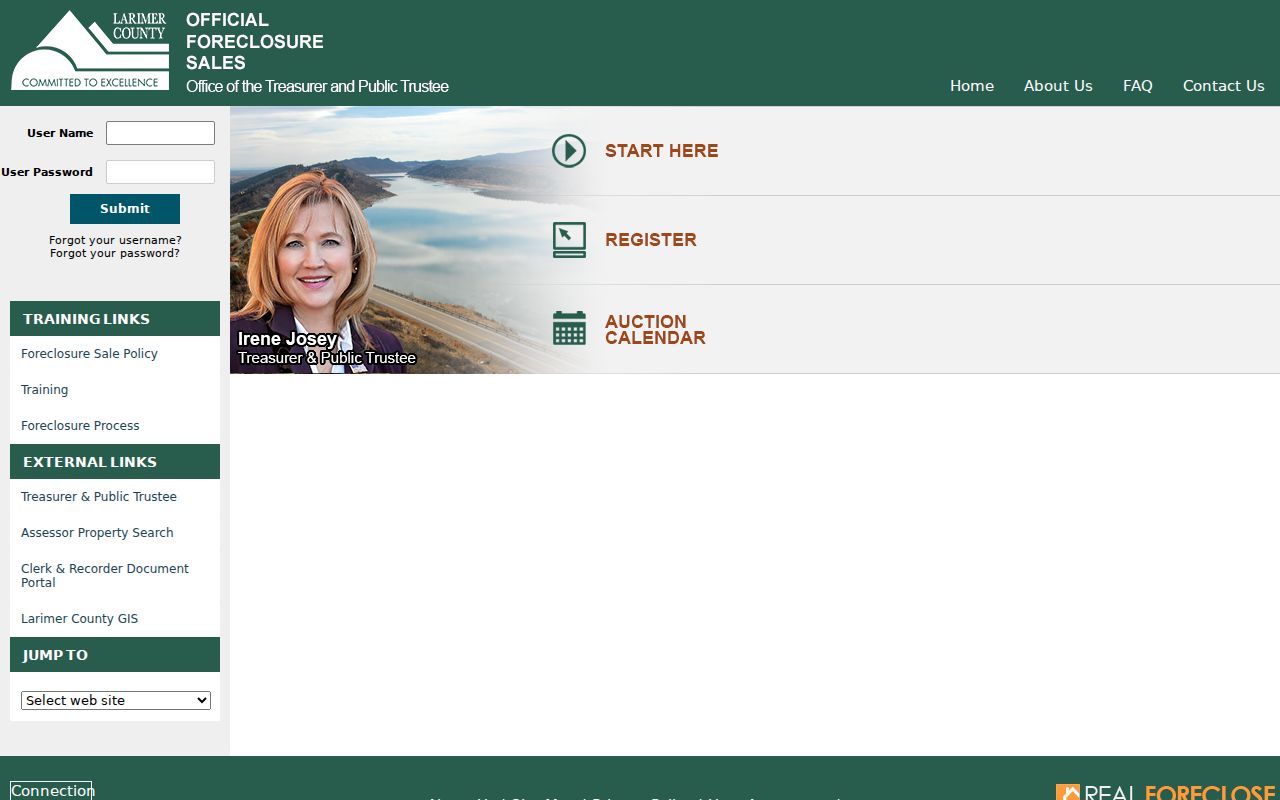
The Public Trustee image marks a foreclosure research channel. It does not identify a household, settle title, or prove who lived at the property.
Note: A Notice of Election and Demand, sale notice, tax lien, and trustee deed are separate events in a Larimer County house history.
Laporte to Fort Collins: Larimer County Households
The 1868 county-seat move is more than background. A person, land parcel, or court matter may be described with Laporte, Fort Collins, a township, or a county label depending on the record date. Records and the jail moved from Laporte to Fort Collins with county business, so an older search should preserve the original place wording.
Fort Collins, Loveland, Berthoud, Estes Park, Wellington, Windsor, Timnath, Johnstown, and rural districts do not share one historical collection. Fort Collins has the longest documented directory and telephone-book run. Loveland has a strong address-history guide and map sequence. Estes Park has oral histories, photographs, newspapers, and town records. A previous-resident question should follow the local source pattern.
The absence of an online image is not proof that the record was destroyed. It can reflect an unscanned series, an in-person index, a transfer, a restriction, or a different keeper. State Archives and local-history staff are the right fallback for a claimed gap.
Limits on a Larimer County Address History
Research into previous residents is strongest when it states what the source actually records. A deed identifies parties to an instrument. A directory identifies a period listing. A census identifies a household at an enumeration date. A Sanborn map identifies building context. A permit identifies an application or project role. None alone proves every person who lived at the address.
Do not publish a protected location from an Address Confidentiality Program or confidential voter record. Do not turn a current mailing address into a claim about physical presence. Keep names, dates, legal descriptions, and source URLs tied to the record that supplied them. If the trail stops at an access boundary, use the custodian's request route rather than guessing.
Lawful house history. Larimer County previous residents research is for personal, lawful family and house history. Do not use historical or current record clues to stalk, harass, track, intimidate, or harm a living person.
A sound conclusion is modest: it names the source, date, place label, person role, and uncertainty. That is enough to make a house history useful without turning a partial record trail into a claim about someone today.