
Larimer County City Directory Holdings by Era
The Larimer County directory shelf is spread across History Connection, Poudre Libraries, the Larimer County Genealogical Society, Loveland local-history holdings, and the Estes Park Museum. The table separates actual year runs from companion collections so a search does not treat a newspaper or oral history as a directory volume.
| Collection | Years | Where Held | Access |
|---|---|---|---|
| Fort Collins directory volumes | 1902-present, with no known 1941-1947 city volumes | History Connection; LCGS cross-check | Listed years scanned or online except 2006-present access not fully verified |
| Fort Collins telephone books | 1927, 1927/28, 1934, 1935/36, 1939/40, 1941-49, 1951-57, 1959/60, 1962-present | History Connection | Fills part of the city-directory gap; check the collection |
| Colorado Business Directory | 1881, 1882, 1885, 1899 | Larimer County Genealogical Society | Society directory holdings and cross-check |
| Larimer County Directory | 1904, 1917, 1966, 1969, 1972, 1975-89, 1992/93 | Larimer County Genealogical Society | County-level comparison to city runs |
| Loveland directory volumes | Most years from 1904-present | Loveland Public Library and Museum/Gallery holdings | Reference librarian help and local-history route |
| Estes Park local-history companions | 1912-2004 newspapers; 300-plus oral histories | Estes Park Museum and town-record route | Person-plus-place research, not a countywide directory |
The exact Fort Collins list includes 1902, 1903, 1904, 1906, 1907, 1908, 1909/10, 1910/11, 1913/14, 1917, 1919, 1922, 1925, 1927, 1929, 1931, 1933, 1934, 1936, 1938, 1940, 1948, 1950, 1952, 1954, 1956-60, 1962-64, 1966, 1968-73, 1975-77, 1979-80-present. The gaps are part of the evidence. Record the volume year and repository instead of smoothing the run into a false annual series.
Fort Collins City Directory Runs and Gaps
The Fort Collins city directory collection has the clearest structure in Larimer County. A volume can contain an alphabetical people and business section, a Street Guide, a Business Section, and a Rural Section. The Street Guide is the address-to-name bridge, while the alphabetical section is better for testing a known surname. The rural section matters when a county search reaches beyond the city grid.
A 1990 Fort Collins scan record is a useful scale marker. It describes a 754-page volume with community and ZIP material, alphabetical residents and businesses, rural listings, a telephone locator, a street and avenue guide, and classified business material. That scan supplies a period clue. It does not certify a current address, title, or legal residence.
The year pattern can be read as a small timeline:
- 1902. The documented Fort Collins city-directory run begins.
- 1904, 1906, and 1907. The collection notes that these volumes lack a Street Guide, so the alphabetical, business, rural, and neighboring-year sections must carry more of the search.
- 1941-1947. No known Fort Collins city volumes are listed. Telephone books fill part of the period, including a 1941-1949 run.
- 1948 onward. City volumes resume in the listed collection, with later runs continuing through 1979-80-present.
The History Connection directory collection is the best place to check the volume year, section, and scan status before drawing a conclusion from a name or street entry.
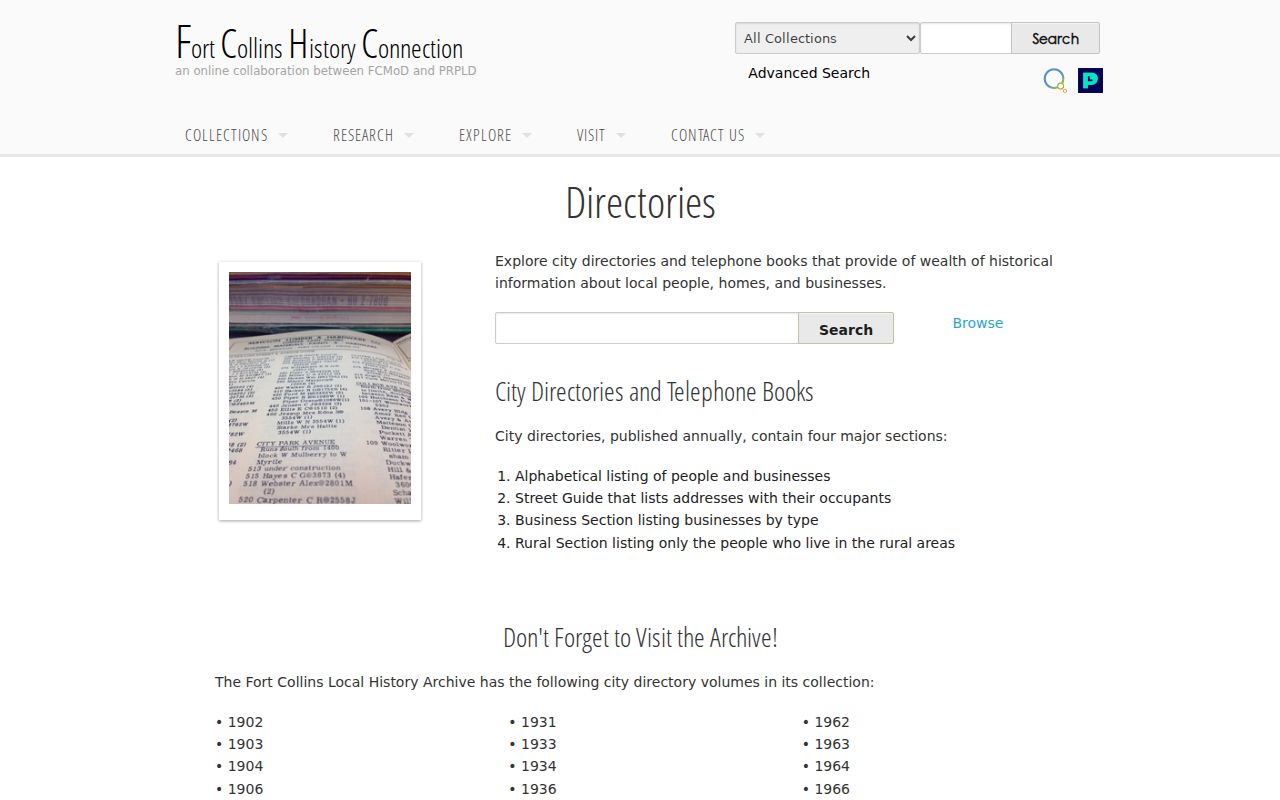
The collection image belongs with the year-run timeline because the repository itself is part of the citation. A page number and section name make a historical clue reproducible.
Poudre Library Clues for Larimer Directories
Poudre Libraries History Connection adds the material that makes a directory useful for family and place history. Newspapers are on microfilm from March-November 1874 and June 1878-present. About 400 oral-history transcripts are available for a three-week checkout and renewal period. Free genealogy and local-history databases sit beside cemetery books arranged by surname.
Sanborn maps printed for Fort Collins from 1886-1940 are available on microfilm, with digital Sanborn access spanning 1867-1970. Coloradoan obituaries run from 1977-present in the library and local-archive holdings, while a database obituary run covers 1999-present. Genealogy books and magazines are reference-only. These distinctions help set the right expectation: a directory gives a dated clue, a newspaper gives an event, and a map gives building context.
For a strong Larimer County directory search, photograph or transcribe the entry, then keep the related newspaper date, map sheet, and cemetery or obituary citation beside it. Oral history can explain a neighborhood memory, but it remains contextual evidence rather than a certified record.
The library's local-history holdings show how a volume fits inside a larger evidence chain.
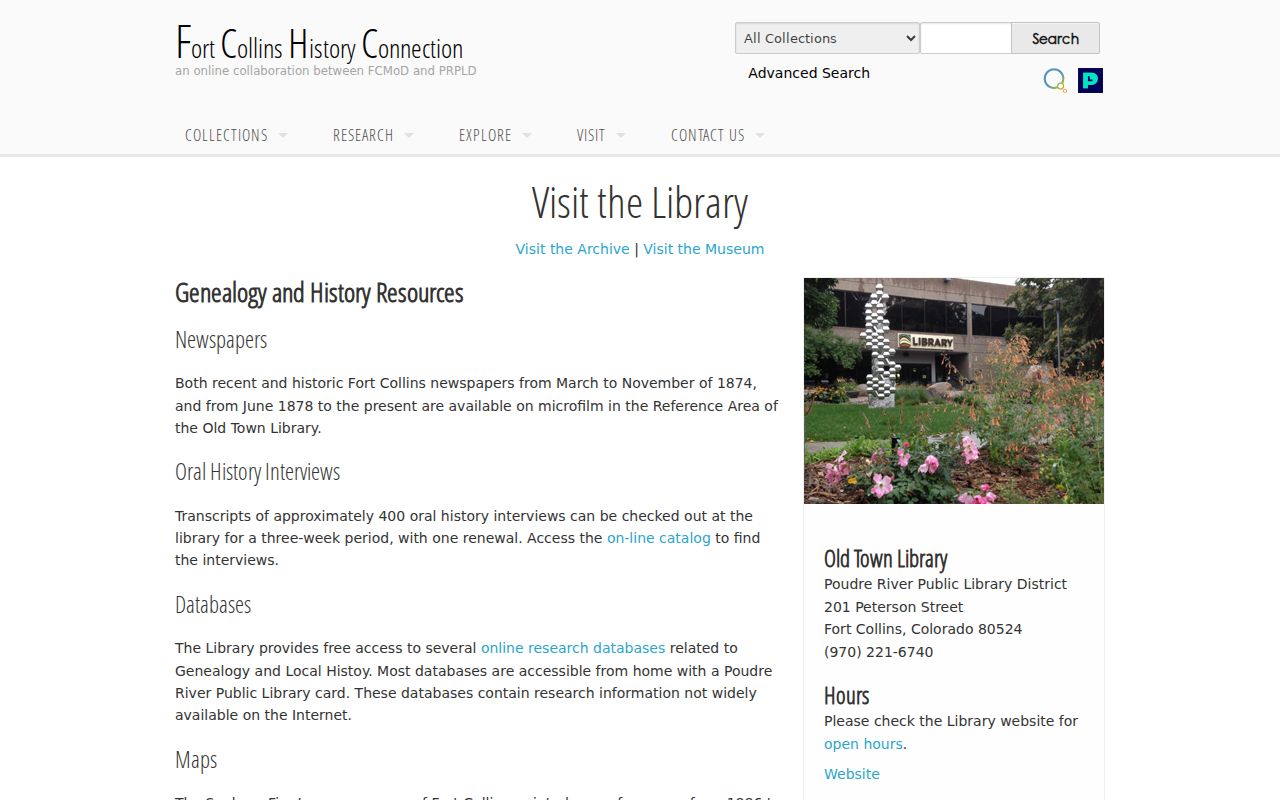
The library image points to the repository route for microfilm, oral histories, Sanborn maps, newspapers, and obituary research.
Read a Larimer County City Directory Entry
A city directory entry is a period snapshot. It may show a name, an address, a business or occupation line, and a locator mark used by that publisher. It does not by itself prove title, current presence, or a complete household. The volume's introduction and abbreviation key control the meaning of symbols.
| Entry feature | What to record | How to use it |
|---|---|---|
| Name | Exact spelling, initials, surname order, and any stated relation | Compare nearby years before treating a name variation as a new person. |
| Occupation or business line | The period wording printed beside the name | Use it as a historical clue and search term, not as proof of identity. |
| Address | House number, street, unit or rural label, plus page and section | Test the address against the Street Guide, map, newspaper, and modern parcel. |
| Spouse or household note | Only the relation or note actually printed in that volume | Preserve the wording and do not fill in an unstated relationship. |
| Owner or renter mark | A symbol or abbreviation only when the volume explains one | Photograph the legend first; do not import a code from another publisher. |
Three terms help when the page layout is unfamiliar:
- Criss-cross directory
- A reverse directory arranged by street or address. It is most useful for testing who was associated with a place in a stated period.
- Householder index
- A name or household locator when a volume provides one. Confirm that the particular volume includes it rather than assuming every directory does.
- Abbreviation key
- The publisher's explanation of short forms and marks. Read it before interpreting a line, since codes vary by volume.
- Street Guide
- The address-order section that links a street and number to a listed person or business. Fort Collins did not include it in the 1904, 1906, and 1907 volumes.
Trace a Larimer County Directory Household
Tracing a household works best when the target year and place are fixed first. “Fort Collins” may refer to a city volume, a rural section, a telephone book, or a neighboring postal route. Loveland and Estes Park require their own collection checks. A first or last appearance is a clue, not proof of a move, death, or change in family structure.
- Set the frame. Write the municipality, street spelling, target year, and any known name variant or middle initial.
- Search the alphabetical section. Record the exact entry, page, publisher, address, and any business or relation line.
- Test the Street Guide. Look for the address in the same volume when that section exists. For 1904, 1906, and 1907, use adjacent years and the other sections instead.
- Compare consecutive volumes. A changed address, first appearance, or disappearance shows a research lead. Check a newspaper or another record before calling it a move.
- Pair the year with a census release. The federal census is available through 1950 under the 72-year rule. Use a census household as a separate dated source, not as a replacement for the directory page.
- Close the trail. Check newspaper microfilm, an obituary index, cemetery books, an oral history, or a map. Cite the repository and the exact page or image.
A directory entry can connect a surname to a street without proving that every person in the dwelling was listed. A missing entry can reflect publication scope, a rural or business section, a name change, or a gap in the collection.
Estes Park Clues in Larimer County Directories
The Estes Park Museum route gives a mountain-community layer that does not look like the Fort Collins directory shelf. Its local-history resources include more than 300 oral histories, newspapers from 1912-2004, about 12,000 photographs, and a town-record route through Laserfiche. These materials can place a person in an event, building, family, or civic setting when a standard volume is thin.
The Estes Park Museum collection page should be read with its own access rules. An oral-history transcript is a memory source. A photograph is a dated visual clue. A town record is an official municipal record when the record is public. None should be silently recast as a complete resident roll.
The Estes Park evidence route shows why a Larimer County directory search should follow the municipality rather than force every community into the Fort Collins pattern.
The museum image represents the person-plus-place archive that can fill a directory gap while keeping oral and visual evidence clearly labeled.
Larimer County Directory Cross-Checks
The Larimer County Genealogical Society is a useful cross-check because it distinguishes Fort Collins city and telephone books from broader county and Colorado directories. Its list reaches from Fort Collins 1902-present, with the 1941-1947 gap, and adds Colorado Business Directory volumes for 1881, 1882, 1885, and 1899. The society also identifies Larimer County Directory volumes for 1904, 1917, 1966, 1969, 1972, 1975-89, and 1992/93.
That list does not mean every item is online or every year is equally complete. It tells a researcher which repository or society description to test next. Record whether a result came from a scan, a local shelf, a catalog note, or a society cross-reference.
The Larimer County Genealogical Society directory holdings are especially useful when a Fort Collins collection gap raises the question of a county-level or business-level listing.
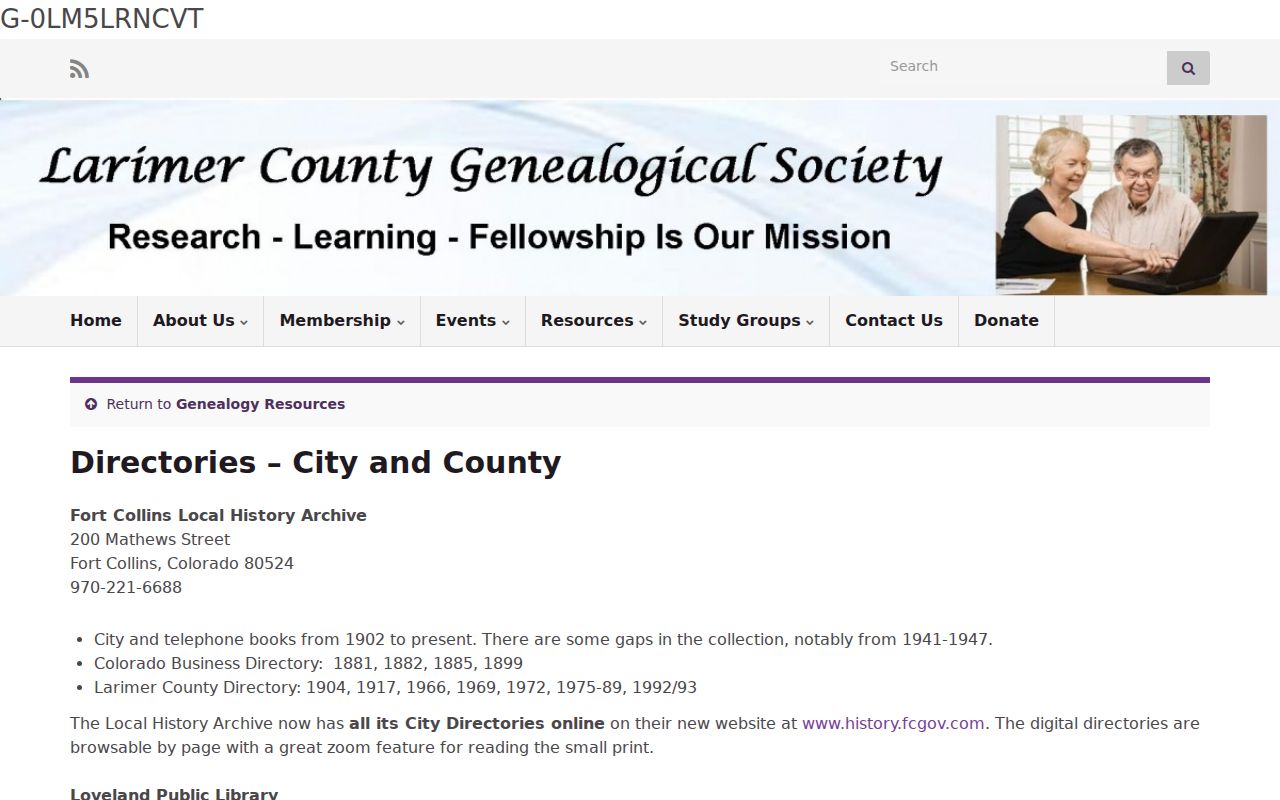
The Larimer County Genealogical Society directory holdings image belongs beside the cross-check method because collection ownership and digital availability are separate facts.
Larimer County Loveland Directory History
The Loveland Public Library historic-building guide says its directory volumes provide former occupants, names, addresses, and occupations for most years from 1904 to the present. The guide points to Museum/Gallery copies and librarian help. It also lists local-history books, oral histories, newspaper microfilm for most Loveland papers since 1891, obituary, birth, name-change, and event index cards, a photo and map index, a vertical file, historic maps, and museum records.
Loveland's Sanborn sequence is unusually specific: June 1886, December 1890, September 1893, November 1900, March 1906, May 1911, April 1918, August 1927, July 1937, and September 1946. The cited 759 E 7th Street architectural-inventory sample demonstrates a method using directories, Assessor data, an appraisal card, permits, newspapers, Sanborn maps, and the federal census. Those sample facts belong only to that address, but the evidence sequence is broadly useful.
When the target is a Loveland house, preserve the guide citation, directory year, street spelling, map date, and any appraisal-card or permit reference. Do not substitute a Fort Collins volume merely because it is easier to search.
Larimer County City Directory Gaps
A gap has several possible causes. The Fort Collins 1941-1947 city run is absent in the documented collection, but telephone books cover part of that span. The 1904, 1906, and 1907 volumes lack a Street Guide. A municipality may have a local shelf that is not digitized. Rural and business listings may sit outside the alphabetical pages.
No single public, countywide digitized resident directory covering Fort Collins, Loveland, Estes Park, Berthoud, Wellington, Windsor, Timnath, Johnstown, and unincorporated communities was located. Rural districts may require a municipal, school, cemetery, church, or society-specific route. Treat a no-result as a collection question first.
Note: A missing Fort Collins volume or Street Guide is a collection feature, not proof that a Larimer County resident was absent.
Larimer County Directory Clues Today
Historical directory work ends with a dated clue, not a current identity claim. Keep the volume, page, section, repository, and exact wording. Then compare the address with current parcel and situs fields, a legal description, a map, or a custodian-held record. A directory may list a business contact, household member, or former address while the modern Assessor record names a different role.
For present-day address fields, move to Larimer County by-street records. If the question narrows from a collection to one person, use the Larimer County resident lookup and keep the historical citation as the reason for the check. The modern result and the historical entry should remain separate statements.
A reliable Larimer County directory trail names what was seen, where it was seen, and what the source cannot establish. That discipline preserves the value of the old shelf without turning it into a false current roster.