
Starting a Larimer County Residents Directory Search
A useful Larimer County residents directory search begins with a defined target. “Who owns this parcel?” calls for the Assessor, GIS and recorded instruments. “Was this person registered here?” calls for the Colorado voter lookup and its limits. “Who lived at this address in 1948?” points to a city directory, newspaper, Sanborn sheet or census clue. A court hearing, birth fact, marriage, business filing or jail entry has its own keeper. No county page found in the research supplies a complete, current name list.
Keep the source purpose in view. The Assessor can show an assessed owner and a mailing location, but it does not certify occupancy. A directory can place a household at a street address for one year, but it is not a deed. A docket row shows a scheduled hearing, not the full case. The strongest match joins two records with a date, parcel, case number, place, or other lawful anchor.
- Name the question. Separate a current parcel clue, a historical resident, a court event, a vital fact, a business link, and a neighborhood question.
- Start with the keeper. Use the Assessor or GIS for an address, the voter lookup for a registration match, or the library for a past household.
- Add a second anchor. Preserve a middle initial, date, ZIP, parcel number, case sequence, directory year, or municipality.
- Check a different record type. Pair a directory clue with a parcel trail, or a docket with a document request.
- Stop at the access boundary. Use a custodian request, library terminal, archive, phone call, mail route, or CORA request when the online index ends.
Larimer County Resident Records Offices
Larimer County resident records sit in separate offices. The Clerk & Recorder holds recorded instruments and election administration. The Assessor organizes parcel, value, owner, mailing, situs and sales fields for assessment work. Courts, vital records and libraries answer different questions. The office that can confirm a record is the custodian named in the source, not a directory summary.
Online portals are useful first stops, but each office offers a human route. The Recorder has an in-person index and copy process. The Assessor and Elections offices can confirm coverage and request rules by phone. Court and vital requests use their own forms. Library and archive staff help when an older volume or paper index is not online.
Larimer County Clerk & Recorder
200 W Oak Street, first floor
Fort Collins, CO
970-498-7860
Larimer County Assessor
200 W Oak Street, second floor
Fort Collins, CO
970-498-7050
Larimer District and County Courts
Fort Collins Justice Center
201 LaPorte Avenue, Suite 100
970-494-3500
Larimer County Parcel Fields and People
The Assessor’s public tables are one of the clearest ways to see why a property record is not a household roll. The Account table ties a parcel or account to a situs address, subdivision, short legal description, tax area, tax year and run date. Owner and Owner Location add NAME1, NAME2, mailing lines, mailing city, state and ZIP. Sales can bridge an assessment record to a Recorder reception number, grantor, grantee, sale date, price and deed code.
The field names are worth saving with a result. A situs address identifies the taxed location. A mailing address identifies where the owner record receives correspondence. Those values can differ, and the Assessor warns that assessment data is not a title guarantee. GIS adds shape, lot, block and subdivision context, while the Recorder supplies the legal instrument. A name in one field should be checked against the record’s purpose and date.
| Search field group | Larimer public-data fields |
|---|---|
| Parcel identity | PARCELNO, ACCOUNTNO, SCHEDULENUM, TAXAREA and ACCTTYPE |
| Situs address | SITUSSTREETNO, SITUSPREDIRECTION, SITUSSTREETNAME, SITUSSTREETTYPE, SITUSPOSTDIRECTION, SITUSUNIT, SITUSADDRESS, SITUSCITY and SITUSZIPCODE |
| Owner location | NAME1, NAME2, MAILADDRESS1, MAILADDRESS2, MAILCITY, MAILSTATE and MAILZIPCODE |
| Transfer clue | RECEPTIONNO, GRANTOR, GRANTEE, SALEPRICE, SALEDATE, DEEDCODE and DEEDDESCRIPTION |
Larimer County’s official profile gives the wider setting for these fields, from plains cities to foothills and mountain communities. That geography is why a postal label, municipal address and county parcel should be recorded separately.
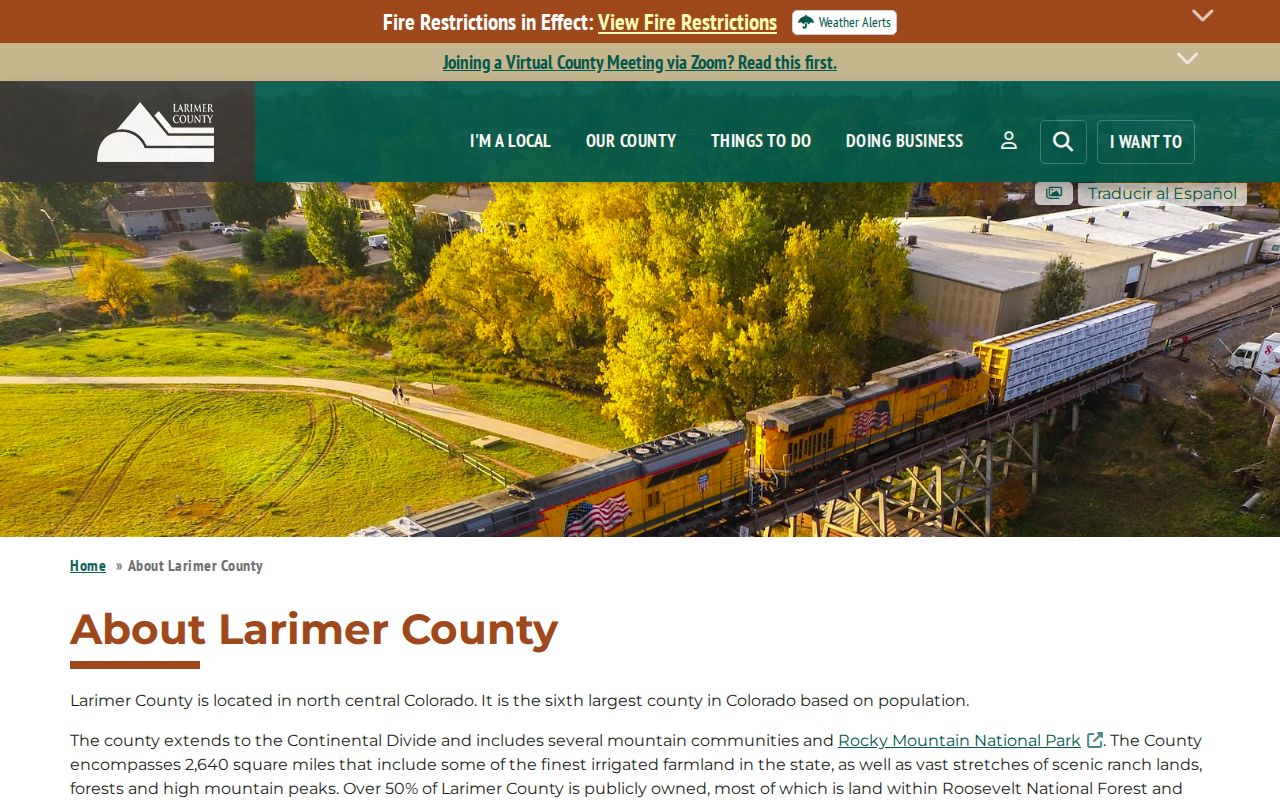
The county profile image is a reminder that a countywide residents directory crosses more than one built environment. A rural parcel, a mountain route and a city lot can require different source chains.
Colorado Voter Lookup for Larimer Names
The public Colorado voter lookup is a narrow match tool. Its visible fields are First, Last, ZIP and Birthday in MM/DD/YYYY format. The state advises entering a name as it appears in the registration, trying the last ZIP after a move, and contacting the county when no match appears. Confidential records and people under 18 may not appear. A match confirms a registration record under voter rules. It does not reveal a vote choice or turn the result into a street-by-street household list.
Larimer Elections also publishes report routes rather than a single resident search. DP-002 covers precinct splits, DP-003 gives counts by party, district and precinct, VR-011 offers current lists subject to exclusions, and EX-004 covers five-election activity. Files may be PDF or delimited text and may use secure FTP. A request for a named individual belongs with the county’s public-record process. Public fields can include a name, residential address, party and party date, phone if provided, gender identity if provided, birth year and prior participation. SSN, driver-license number, month and day of birth, signature and email are confidential.
| Lookup input | What the result can establish |
|---|---|
| First and last name | A possible registration match, subject to spelling and record protection. |
| ZIP | A search aid that may need the last ZIP after a move. |
| Birthday | A match input, not a public display of the full birth date. |
| County report | Precinct, district, party, turnout or activity totals, with confidential records omitted. |
The voter lookup source captured for Larimer County shows the simple input pattern and the no-match caution. Save the date of the check because voter data can change.
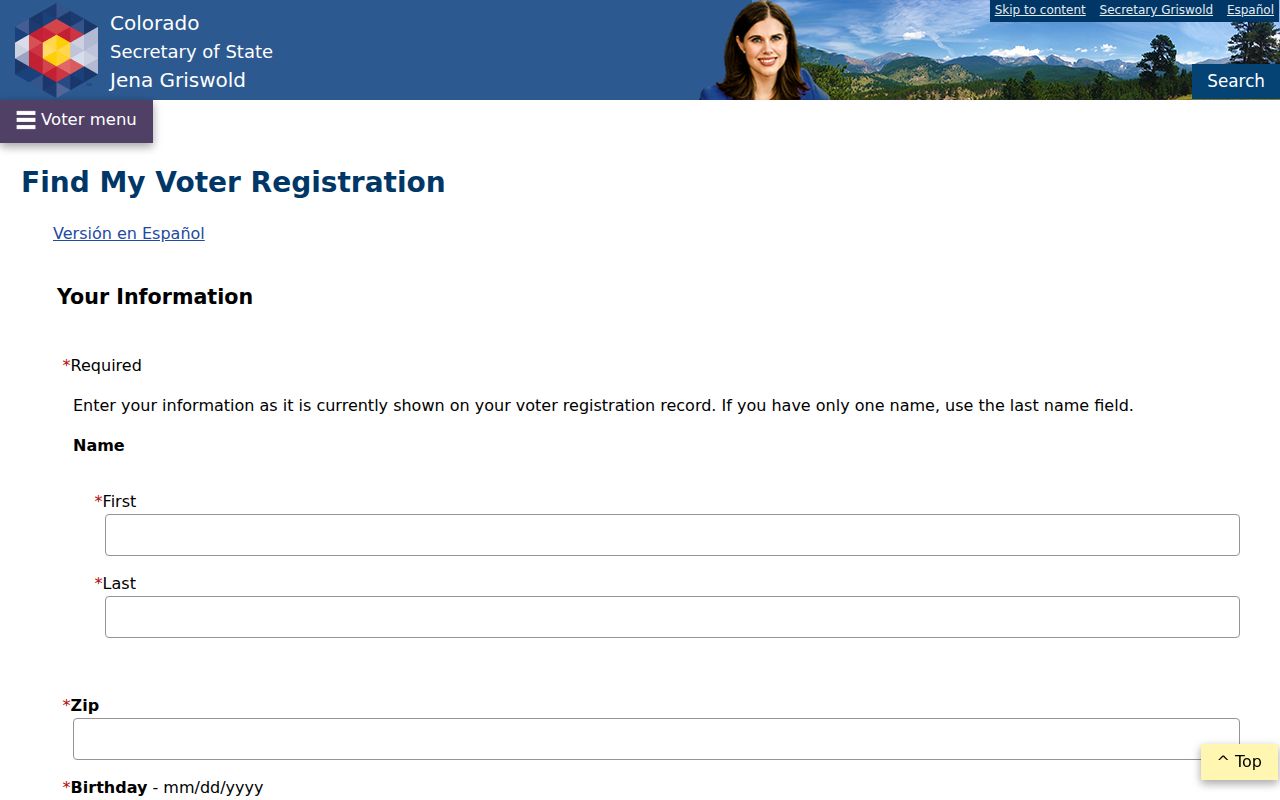
The image connects a name search to its actual limits. Registration evidence is one piece of a Larimer County residents directory search, not proof of every person at an address.
Current Larimer County Residents Directory Sources
A current Larimer County residents directory is assembled from records with different definitions of “person.” The Assessor is parcel-centered. The Recorder is instrument-centered. Voter files are registration-centered. A permit portal is project-centered, and a city clerk is action-centered. Put the source name and date beside each result so a later reader can tell what the record actually says.
| Source | Best question | Keeper | Access route |
|---|---|---|---|
| Assessor and GIS | Which assessed owner and parcel fields match an address? | Larimer Assessor / Enterprise GIS | Property search, public tables, map Identify, phone or counter |
| Landmark Web | Which parties and instruments appear in the recording index? | Clerk & Recorder | Free index, paid or registered images, in-person books and copies |
| Voter lookup and reports | Does a registration match, or what does a precinct report show? | Colorado SOS / Larimer Elections | Online match, data request, reports, email, mail or counter |
| Permits and planning | Who is named on a public project or address file? | County or municipal office | Citizen Self-Service, city portal, clerk request or archive |
| Directories and newspapers | Who was listed at a place in a named year? | History Connection, libraries, museums and societies | Digitized scans, microfilm, reference help and archive visit |
The correct next step depends on the question. A parcel clue can move into the Larimer County resident lookup workflow when one person needs verification. A street-wide question belongs with the address records and map layers on the By Street page.
Landmark Web as a Larimer County Resident Trail
Larimer County’s Landmark Web is an index to recorded instruments, not a narrative history of each household. Its modes include Name, Document, Book and Page, Consideration, Record Date, Reception Number and Legal. Name searches can use Starts With or Contains, last and first name fields, a date range, a document category and a result count that can rise from 100 to 2,000. Legal and Advanced Legal searches use subdivision, lot, block, section, township and range details.
A result row may show the reception number, record date, document code, grantor, grantee, legal description and book/page-style reference. The index points to an instrument. It is not a title opinion, and an indexed name is not automatically a unique person. Visitors can inspect the index without an account, while registered users may see watermarked images and unwatermarked downloads may require payment. If the target is old, read the coverage statements carefully: the current Easy Access page says 1971-present, while the navigation guide says 1939-present and sends pre-1939 work to grantor/grantee books.
- Roll
- A record set kept for a stated public purpose, such as assessment or voter administration.
- Index
- A finding aid that points to a record; it is not the full image or a certified conclusion.
- Parcel
- A mapped piece of land tied to an account, legal description and tax fields.
- Criss-cross directory
- A reverse directory arranged by address, useful for a period clue about a household.
The Landmark Web source page shows the search modes that make a deed, lien, plat, easement or other instrument findable. For a resident trail, carry the reception number into the Assessor Sales table and then read the instrument itself.
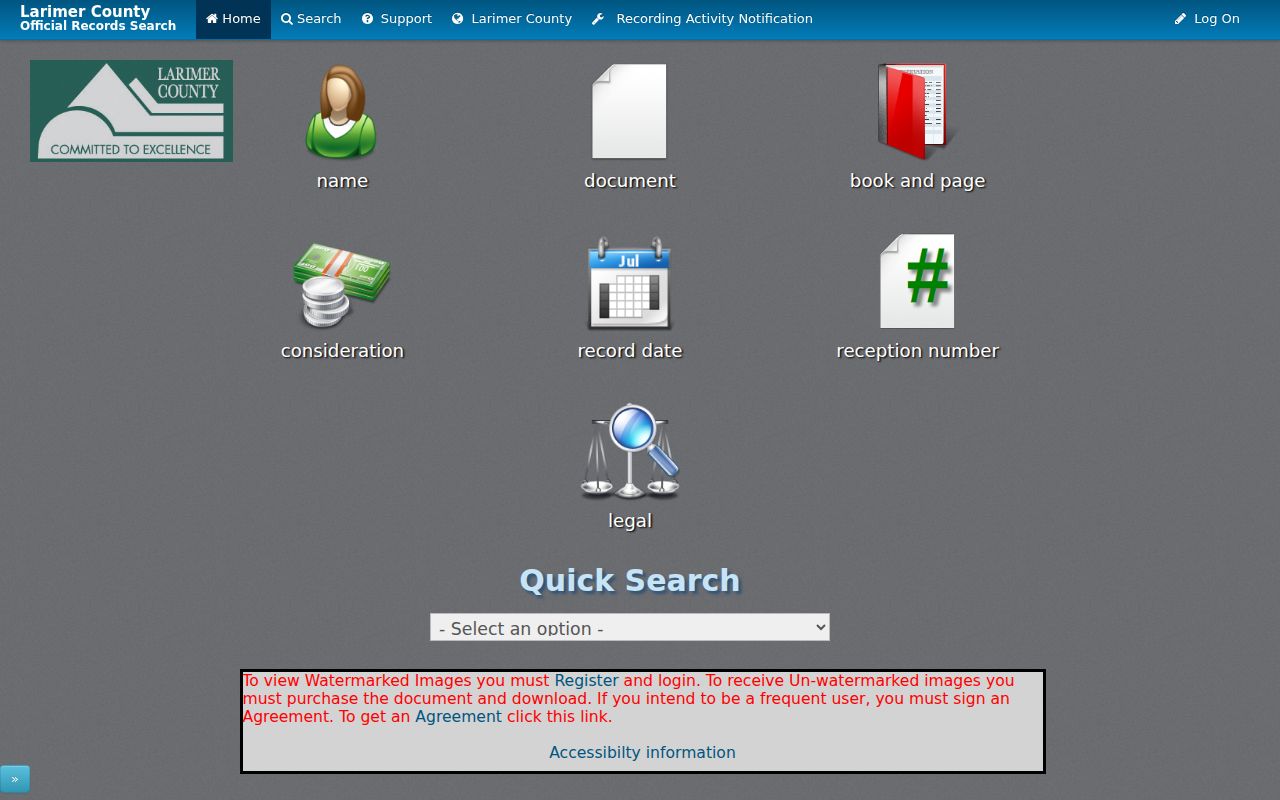
The recording-index image belongs beside the field explanation because the visible result is a pointer. It should be paired with a second record before a name or address conclusion is made.
Larimer County Courts and Vital Records
The Colorado Judicial Branch docket helps locate a Larimer hearing. Choose a district, county, courthouse, court type and division, then narrow by date, case year, class, sequence, party or attorney. Results can show date, time, duration, name, case number, hearing type, location, appearance type and courtroom. The public screen is date-driven and may show only a near-term hearing window. A docket row does not contain every pleading, judgment or piece of evidence.
For a document, use the Judicial Branch request form with the case number, type, year, county, party details and requested family, criminal, civil, probate or register-of-action material. The normal response target is three business days, with page, search, certification, retrieval and research charges described by the form. Birth records follow a different route. Larimer Vital Records serves Colorado births from 1900-present at 1525 Blue Spruce Drive, with ID, eligibility proof, appointments, mail or online ordering. Colorado vital records are confidential under C.R.S. 25-2-117. Marriage, divorce and death records have distinct custodians and access rules, and no blanket current death opening period was confirmed.
The Larimer docket page and the county’s state vital-record route should be treated as separate source paths. A cemetery, obituary or directory can supply a clue, but a certified vital record requires the proper relationship or direct and tangible interest.
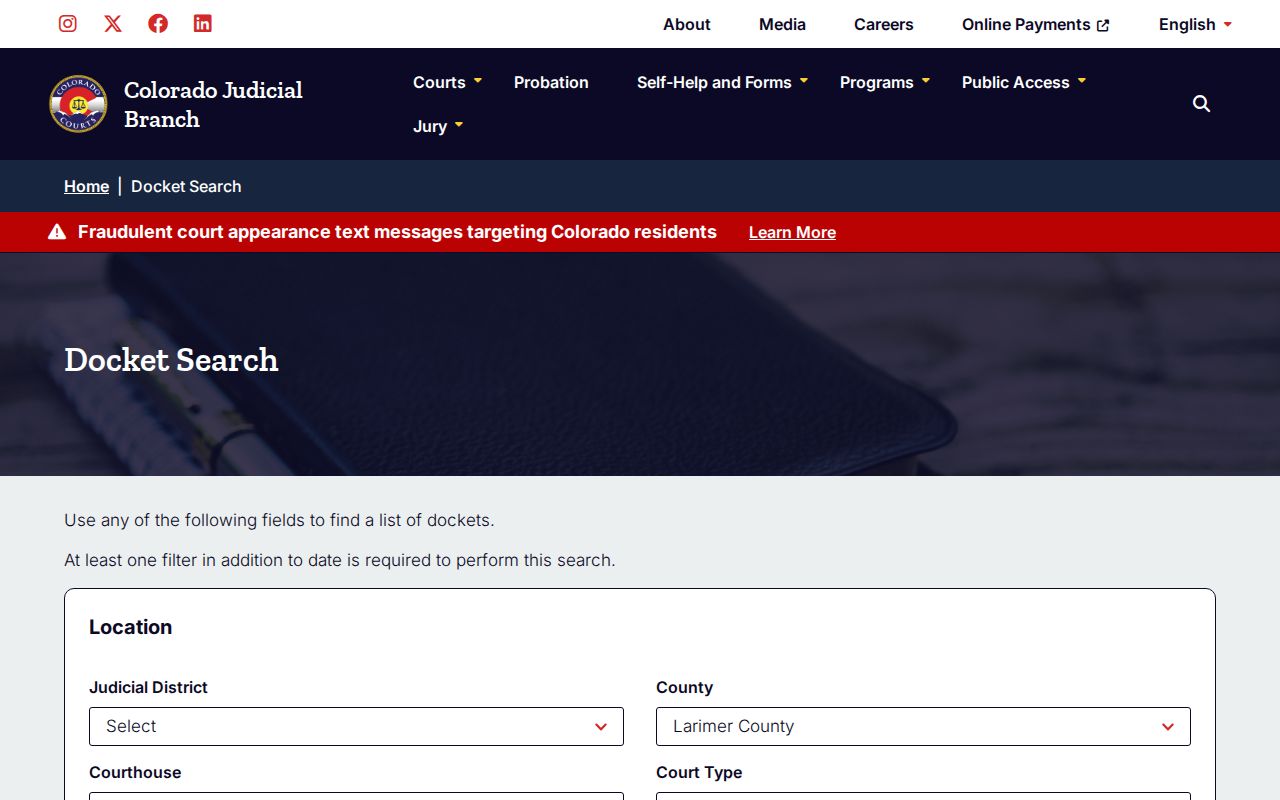
The docket image shows why a court match needs a case number and record request when the goal is verification rather than a scheduled event.
Larimer County Business and License Clues
A person may appear in a public business or license record without that filing proving a current home address. The Colorado Secretary of State search accepts a business name, trademark, trade name, ID or document number. Advanced search adds filing dates, agent or registrant names, individual fields, organization fields, exact-match options, sorting and pagination. An individual trade-name filing records a true name, business address, trade name, description, filer and a $20 filing amount. Treat each as a dated filing event.
DORA’s public verification asks for profession, license type, license number, status, last name and first or middle name. A person or facility toggle and wildcard asterisk can broaden a search. Not every occupation is regulated, and a license profile is not a resident roster. The Great Colorado Payback search can also use a name, former name, business or former ZIP, but claim proof belongs with Treasury.
The Colorado Secretary of State business search is the source captured for a business-linked clue.
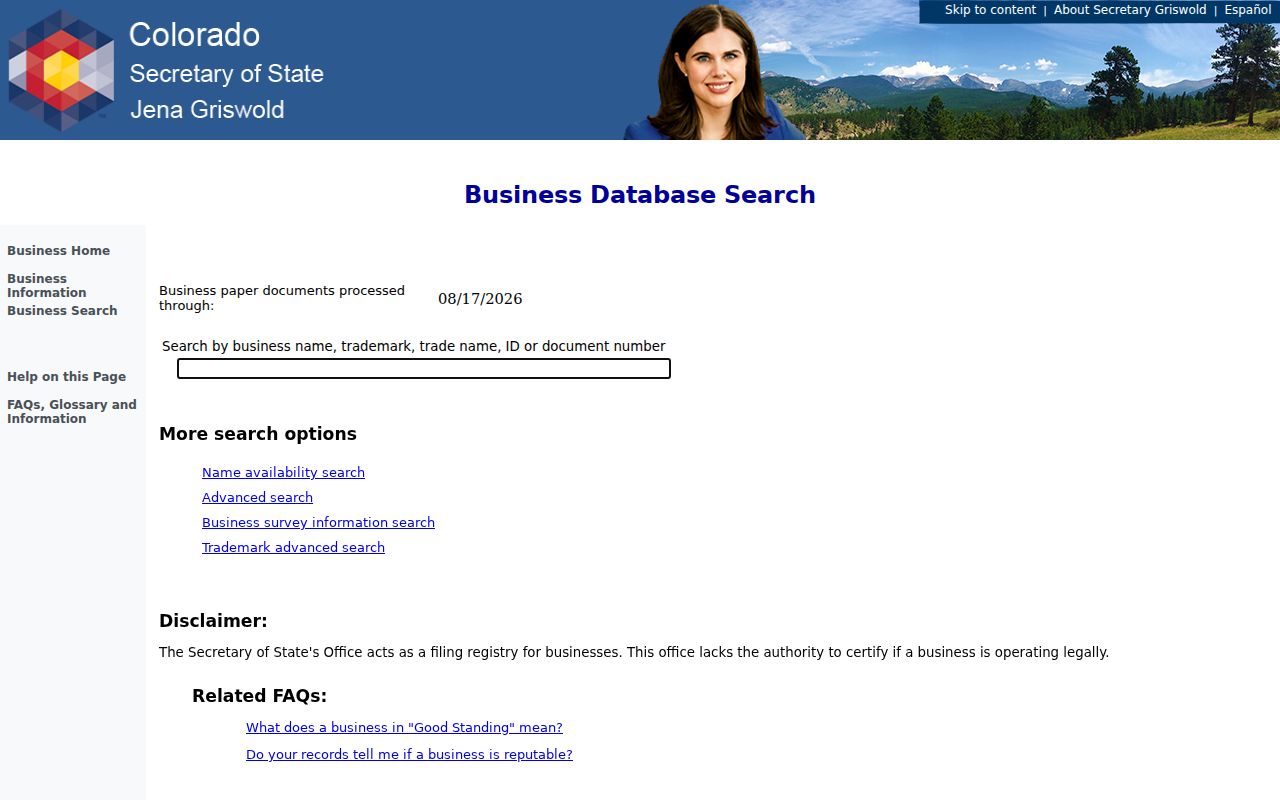
The image illustrates a registry that can connect a name to an organization or filing, not a conclusion about personal residence.
Colorado license verification provides a different kind of public record.
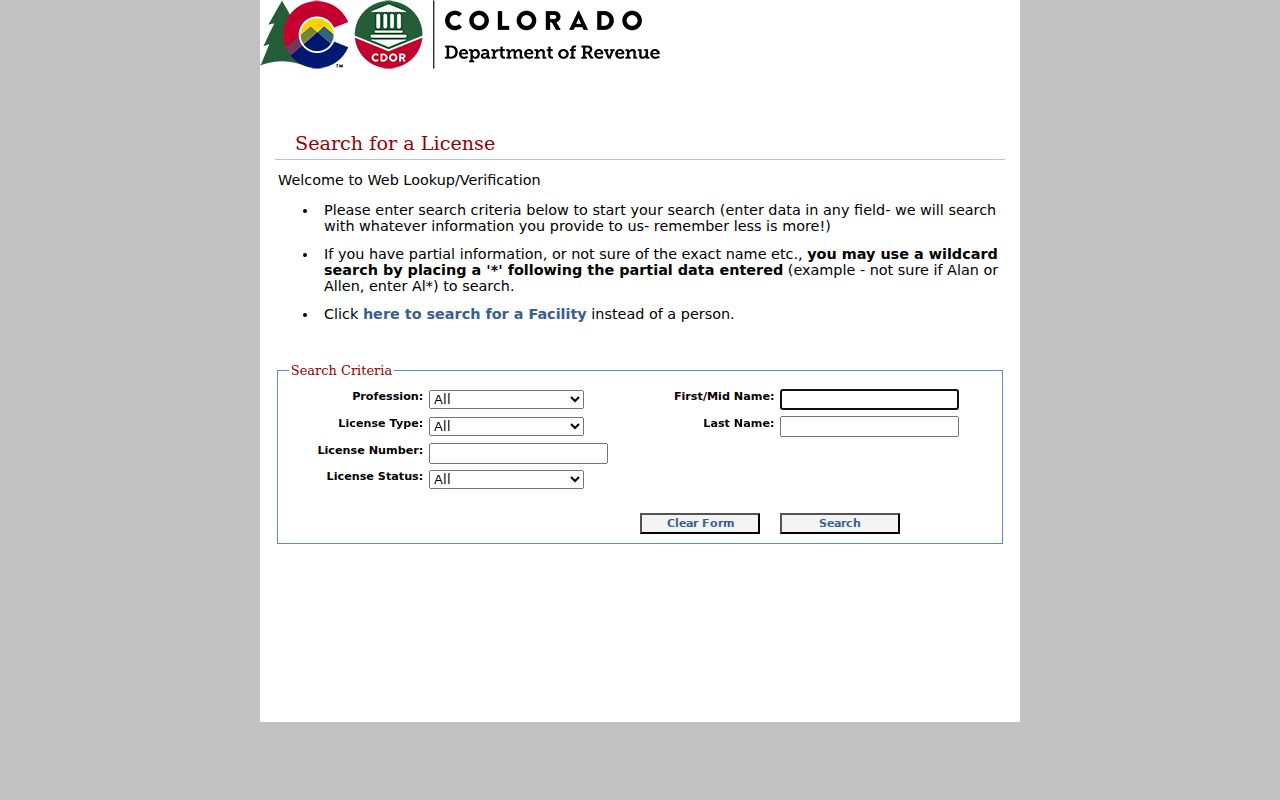
Compare the license number, profession and status before treating a name match as meaningful. A business or license trail can support civic, family-history or consumer-safety research when its scope stays clear.
Historical Larimer County Resident Directories
Fort Collins directory work begins with History Connection’s collection, which lists city volumes from 1902 forward with gaps. There are no known Fort Collins city directories for 1941-1947, but telephone books fill part of that stretch. A volume may have an alphabetical people and business section, Street Guide, Business Section and Rural Section. The 1904, 1906 and 1907 books lack a Street Guide, so an unsuccessful address search in one of those years is a collection limitation, not proof that no one lived there.
Loveland’s local-history route covers most years from 1904 and pairs directories with newspaper microfilm, vertical files, oral histories, historic maps and Sanborn sheets. Estes Park adds town records, photographs, oral histories and newspapers. The county seat moved from Laporte to Fort Collins in 1868, so an early person or parcel can appear under changing county-seat and township descriptions. Full collection coverage and the reading method are on the Larimer County city directories page.
ZIP Geography in a Larimer County Residents Directory
The county ZIP map returned 26 ZIP polygons, including two visible pieces for 80521. ZIP 80521, 80524, 80525, 80526 and 80528 provide Fort Collins-area clues without drawing neighborhood lines. Mountain codes such as 80510, 80512, 80515, 80532, 80540 and 80545 require address-level postal checks. Edge codes such as 80503, 80504, 80516 and 80612 reach adjacent-county context. A ZIP is a delivery clue, not a municipal boundary or a complete Larimer County residents directory.
Use USPS By Address for a precise street, the Assessor’s SITUSZIPCODE and MAILZIPCODE for parcel fields, and the voter lookup ZIP only as a match input. The Census distinction between ZIP Codes and ZCTAs matters when a map or statistic is used. No official Larimer ZIP split or realignment year was located, so a historical change should be documented through USPS or a local notice rather than guessed.
USPS ZIP Lookup can return an address, city/state or cities-by-ZIP result, but it warns that a result does not guarantee a real or deliverable address.
Law Enforcement and Unclaimed Name Trails
Larimer’s Booking Report has separate tabs for inmates, bookings, releases, incident blotter, jail population and transient or homeless bookings. Visible fields can include inmate number, birth date, sex, race, hold reason, arrest date and location, charge, bond and an upcoming court date. The report is a recent, short-window resource. A no-result is not a complete historical negative. State DOC custody and the CBI registry have their own scope, refresh timing, exclusions and identity warnings.
Unclaimed property is a gentler name trail for family history. The Great Colorado Payback search accepts names, former names, businesses and former ZIPs, while Treasury handles identity proof for a claim. The result is a lead, not evidence of a current address. Use the official portal directly and preserve the result date.
The Great Colorado Payback source captured for Larimer County explains the search and claim route.
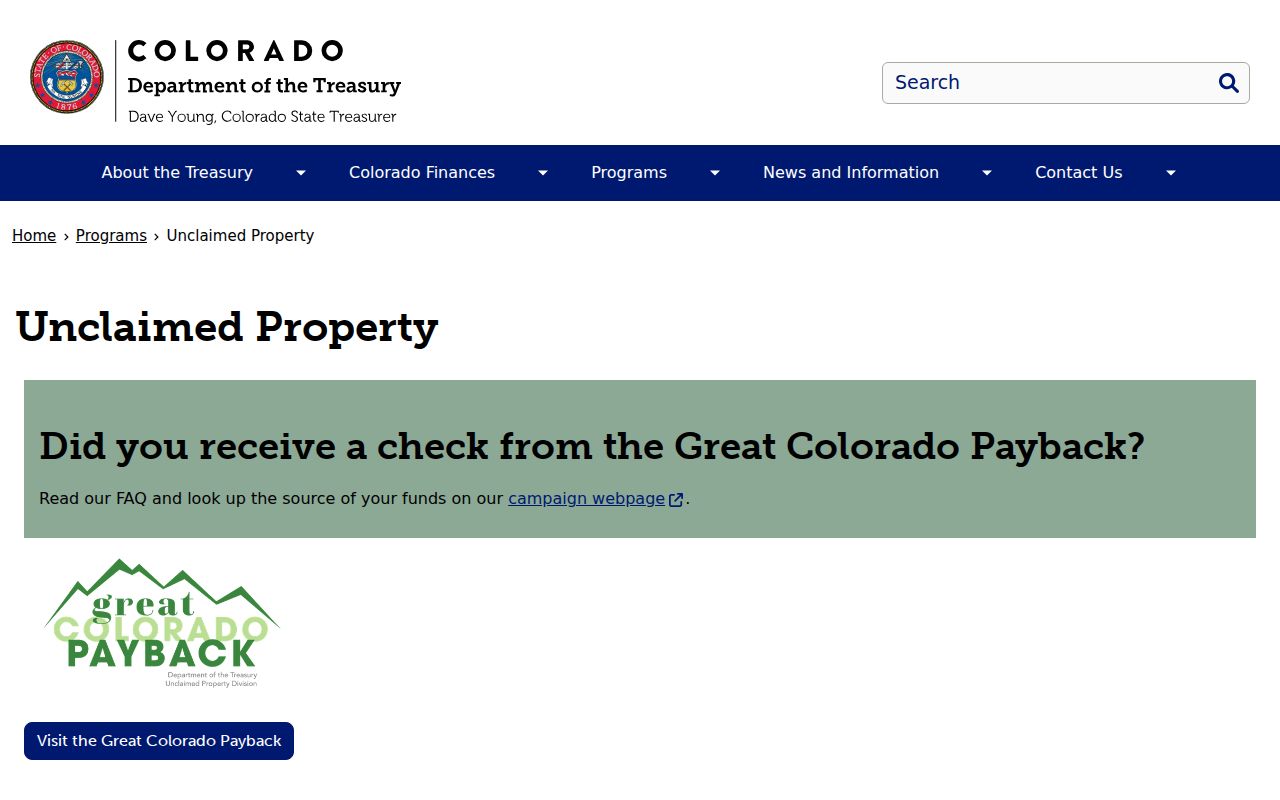
The image belongs in a name-search workflow because an unclaimed-property hit can connect a former name or ZIP to an official claim process without pretending to be a resident index.
Requests When Larimer Portals Stop
When an index is missing, narrow the request before sending it. Colorado Open Records Act procedures let a requester identify the custodian, record type, date range, names, addresses and preferred format. Larimer procedures describe written channels, a three-working-day initial response, a possible seven-day extension, estimates or deposits, and page, staff or computer fees. Email, fax, mail and hand delivery may be available through the responsible office.
Use the right fallback for the record. Recorder books and copies may require the 200 W Oak counter. Court documents use the Judicial Branch request form. Birth certificates use the county or CDPHE route with ID and eligibility proof. Sheriff requests use the records process. Library and archive staff can bridge a directory, newspaper or map gap. A phone call can confirm coverage, fee, appointment and delivery details, but it does not replace a written request when the custodian requires one.
Larimer County CORA procedures are the best starting point for a record that is not exposed by the residents directory’s linked portals.
Privacy Protections in Larimer County
Privacy changes what a Larimer County residents directory can responsibly show. Colorado’s Address Confidentiality Program uses a substitute address and mail forwarding for qualified survivors, and Larimer’s voter-record confidentiality form protects the voter-record address for listed eligible categories. A protected voter may be omitted from ordinary reports. The Clerk & Recorder also accepts specific recording redaction requests for certain identity fields. Protected court, vital and law-enforcement material remains controlled by its own rules.
The Colorado Privacy Act provides rights for covered personal data under thresholds, but public government data is excluded from that definition. It does not create a universal deletion request against the Assessor or Recorder. Direct correction or suppression questions to the custodian or program. Do not combine public fragments into a sensitive profile, publish a protected location, or infer a person’s presence from an owner mailing field.
Lawful personal use. Larimer County records support family history, civic research and address verification within the source’s rules. Never use a name, address, court, voter, jail or registry result to stalk, harass, intimidate or harm anyone.
Colorado’s Address Confidentiality Program explains the substitute-address route. A public record is not permission to seek a protected underlying location.
Recent Larimer County Records Changes
Several recent changes affect how a Larimer County residents directory should be read. The Clerk & Recorder launched a free Recording Activity Notification service on 16 January 2024. It can monitor a personal, business or trust name and send notice when a new county recording appears. Add name variants, but remember that it watches new recordings, does not prevent fraud and can produce false matches.
Address research also has a current wrinkle. Larimer’s Road Naming and Site Addressing System Resolution was adopted in September 2025. The county process can rename a duplicate, similar or unnamed private drive after notice and a 45-day suggestion period, then notify emergency services, the Assessor and USPS. USPS may deliver under the old address for up to one year. Preserve both labels when a directory, parcel or newspaper uses an older number. Current fees, portal fields and confidentiality rules should always be checked with the named custodian before relying on a result.
Larimer’s Recording Activity Notification details provide the dated service context behind this change.