
Starting a Larimer County Residents Directory Search
Start a Larimer County residents directory search with a target, not a fishing trip. "Who owns this parcel?" is an assessor question. It pulls in GIS layers and recorded instruments. "Was this person registered here?" goes to the Colorado voter lookup, with its limits. "Who lived at this address in 1948?" points to a city directory, a newspaper, a Sanborn sheet, or a census clue. Each question has its own keeper. Courts, vital records, business filings, and jail entries answer to separate offices. No county page supplies a complete, current name list.
Keep each source's purpose in view. The Assessor shows an assessed owner and a mailing location, but never certifies occupancy. A city directory can place a household at a street address for one year, though it is not a deed. A docket row proves a scheduled hearing, not the whole case. The strongest match joins two records through a date, parcel, case number, place, or other lawful anchor.
- Name the question. Separate a current parcel clue, a historical resident, a court event, a vital fact, a business link, and a neighborhood question.
- Start with the keeper. Use the Assessor or GIS for an address, the voter lookup for a registration match, or the library for a past household.
- Add a second anchor. Preserve a middle initial, date, ZIP, parcel number, case sequence, directory year, or municipality.
- Check a different record type. Pair a directory clue with a parcel trail, or a docket with a document request.
- Stop at the access boundary. Use a custodian request, library terminal, archive, phone call, mail route, or CORA request when the online index ends.
Larimer County Resident Records Offices
Larimer County resident records live in separate offices. The Clerk & Recorder keeps recorded instruments and runs election administration. The Assessor organizes parcel, value, owner, mailing, situs, and sales fields for assessment work. Courts, vital records, and libraries answer different questions entirely. The custodian named in a source confirms a record, not a directory summary.
Online portals make good first stops. Each office still keeps a human route. The Recorder offers an in-person index and copy process, and the Assessor and Elections desks will confirm coverage and request rules by phone. Court and vital requests use their own forms. Library and archive staff step in when an older volume or paper index stays offline.
Larimer County Clerk & Recorder
200 W Oak Street, first floor
Fort Collins, CO
970-498-7860
Larimer County Assessor
200 W Oak Street, second floor
Fort Collins, CO
970-498-7050
Larimer District and County Courts
Fort Collins Justice Center
201 LaPorte Avenue, Suite 100
970-494-3500
Larimer County Parcel Fields and People
The Assessor's public tables show exactly why a property record is not a household roll. The Account table ties a parcel to a situs address, subdivision, short legal description, tax area, tax year, and run date. Owner and Owner Location add NAME1, NAME2, mailing lines, mailing city, state, and ZIP. Sales bridges assessment to the Recorder side. A sales row can carry a reception number and grantor. It can also carry grantee, sale date, price, and deed code.
Save the field names with any result. A situs address marks the taxed location. A mailing address marks where the owner record receives correspondence. The two can differ. The Assessor also warns that assessment data is no title guarantee. GIS adds shape, lot, block, and subdivision context. The Recorder supplies the legal instrument itself. Check any name against the record's purpose and date.
| Search field group | Larimer public-data fields |
|---|---|
| Parcel identity | PARCELNO, ACCOUNTNO, SCHEDULENUM, TAXAREA and ACCTTYPE |
| Situs address | SITUSSTREETNO, SITUSPREDIRECTION, SITUSSTREETNAME, SITUSSTREETTYPE, SITUSPOSTDIRECTION, SITUSUNIT, SITUSADDRESS, SITUSCITY and SITUSZIPCODE |
| Owner location | NAME1, NAME2, MAILADDRESS1, MAILADDRESS2, MAILCITY, MAILSTATE and MAILZIPCODE |
| Transfer clue | RECEPTIONNO, GRANTOR, GRANTEE, SALEPRICE, SALEDATE, DEEDCODE and DEEDDESCRIPTION |
Larimer County runs from plains cities to foothills and mountain communities, and Larimer County's official profile gives the wider setting for these parcel fields. That geography matters. Record a postal label, a municipal address, and a county parcel separately.
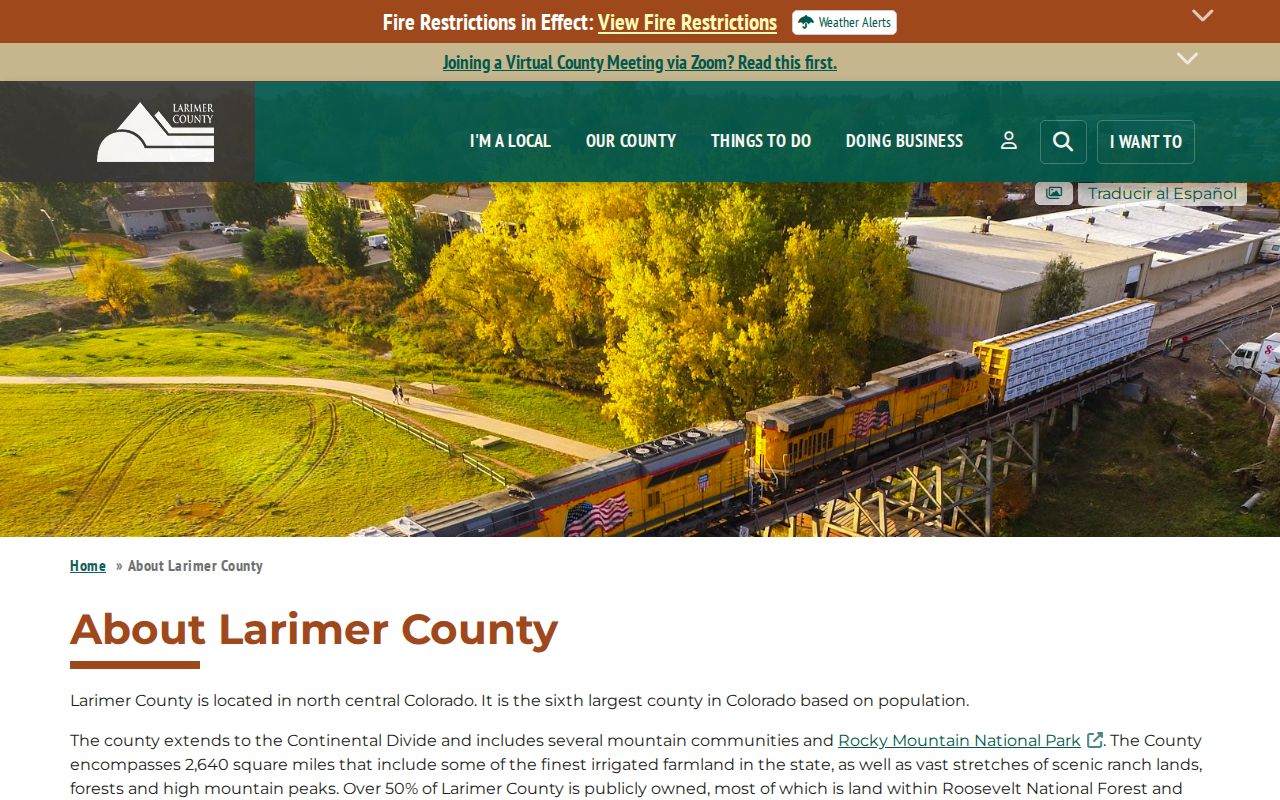
The county profile makes a simple point. A countywide residents directory crosses more than one built environment. A rural parcel, a mountain route, and a city lot can each demand a different source chain.
Colorado Voter Lookup for Larimer Names
Colorado's public voter lookup is a narrow match tool. Its visible fields are First, Last, ZIP, and a birthday in MM/DD/YYYY format. Enter the name as it appears in the registration. After a move, try the older ZIP. The state directs voters with no match to contact the county. Confidential records stay hidden. People under 18 may not appear either. A match confirms a registration record under voter rules and nothing more. It reveals no vote choice, and it builds no street-by-street household list.
Larimer Elections publishes report routes rather than one resident search. DP-002 covers precinct splits. DP-003 gives counts by party, district, and precinct. VR-011 offers current lists subject to exclusions. EX-004 tracks five-election activity. Files may arrive as PDF or delimited text, sometimes over secure FTP. A request for a named individual goes through the county's public-record process. Public fields can include a name, residential address, party and party date, phone if provided, gender identity if provided, birth year, and prior participation. SSN, driver-license number, month and day of birth, signature, and email stay confidential.
| Lookup input | What the result can establish |
|---|---|
| First and last name | A possible registration match, subject to spelling and record protection. |
| ZIP | A search aid that may need the last ZIP after a move. |
| Birthday | A match input, not a public display of the full birth date. |
| County report | Precinct, district, party, turnout or activity totals, with confidential records omitted. |
The state's voter lookup page shows the simple input pattern and the no-match caution. Voter data can change, so date every lookup.
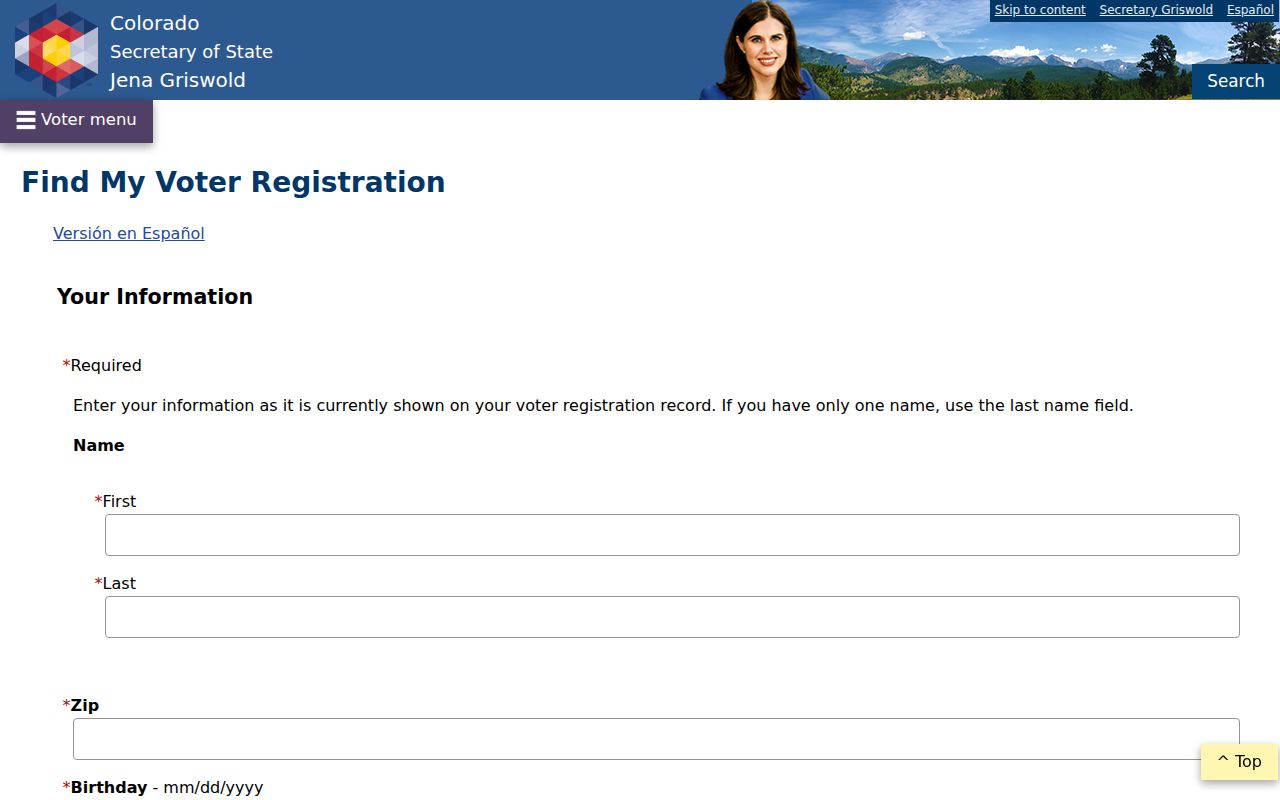
The image ties a name search to its real limits. Registration evidence is one piece of a Larimer County residents directory search, not proof of every person at an address.
Current Larimer County Residents Directory Sources
Building a current Larimer County residents directory means blending records that define “person” differently. The Assessor is parcel-centered. The Recorder is instrument-centered. Voter files center on registration. A permit portal centers on projects. A city clerk centers on actions. Label each result with its source and date. Then a later reader knows what the record actually says.
| Source | Best question | Keeper | Access route |
|---|---|---|---|
| Assessor and GIS | Which assessed owner and parcel fields match an address? | Larimer Assessor / Enterprise GIS | Property search, public tables, map Identify, phone or counter |
| Landmark Web | Which parties and instruments appear in the recording index? | Clerk & Recorder | Free index, paid or registered images, in-person books and copies |
| Voter lookup and reports | Does a registration match, or what does a precinct report show? | Colorado SOS / Larimer Elections | Online match, data request, reports, email, mail or counter |
| Permits and planning | Who is named on a public project or address file? | County or municipal office | Citizen Self-Service, city portal, clerk request or archive |
| Directories and newspapers | Who was listed at a place in a named year? | History Connection, libraries, museums and societies | Digitized scans, microfilm, reference help and archive visit |
The right next step depends on the question. A parcel clue can feed the Larimer County resident lookup workflow when one person needs verification, while a street-wide question belongs with the address records and map layers on the By Street page. Match the tool to the scope.
Landmark Web as a Larimer County Resident Trail
Landmark Web indexes recorded instruments for Larimer County. It is not a household history. Search modes include Name, Document, Book and Page, Consideration, Record Date, Reception Number and Legal. A name search offers Starts With or Contains matching. You can add last and first name fields, a date range, a document category, and a result count that runs from 100 up to 2,000. Legal and Advanced Legal searches dig into subdivision, lot, block, section, township and range details. Each result row is only a pointer. A row shows the reception number, record date, document code, grantor, grantee, legal description and a book/page-style reference. It offers no title opinion. An indexed name may not even be a unique person. Anyone can inspect the index without an account. Registered users may see watermarked images, and unwatermarked downloads may require payment. For older targets, read the coverage statements carefully: the current Easy Access page says 1971-present, the navigation guide says 1939-present, and pre-1939 work belongs in the grantor/grantee books.
- Roll
- A record set kept for a stated public purpose, such as assessment or voter administration.
- Index
- A finding aid that points to a record; it is not the full image or a certified conclusion.
- Parcel
- A mapped piece of land tied to an account, legal description and tax fields.
- Criss-cross directory
- A reverse directory arranged by address, useful for a period clue about a household.
The Landmark Web source page lays out the search modes that make a deed, lien, plat, easement or other instrument findable. For a resident trail, carry the reception number forward. Move it into the Assessor Sales table. Then read the instrument itself.
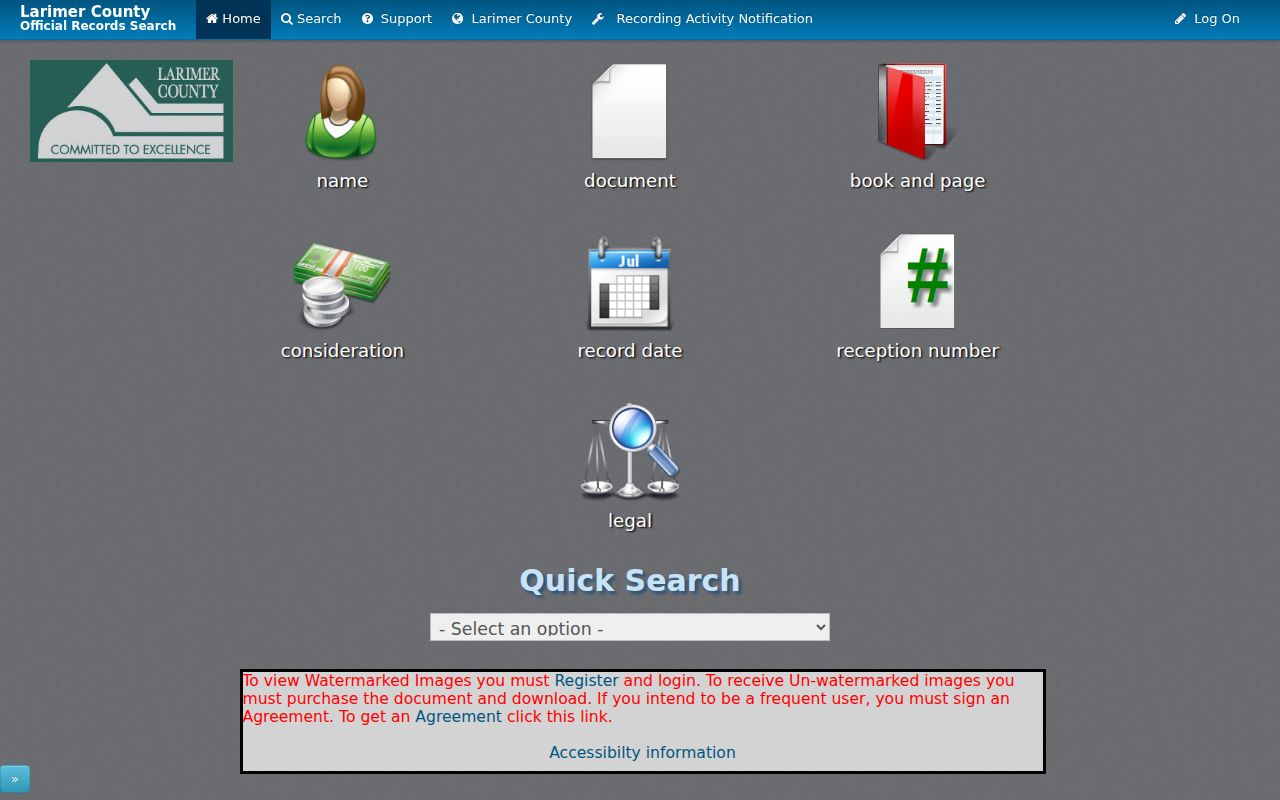
The recording-index screenshot sits beside the field explanation because its result row is only a pointer. Pair it with a second record first.
Larimer County Courts and Vital Records
The Colorado Judicial Branch docket helps locate a Larimer hearing. Pick a district, county, courthouse, court type and division. Narrow by date, year, class, party or attorney. Results show date, time, duration, name, case number, hearing type, location, appearance type and courtroom. The public screen is date-driven. It may show only a near-term hearing window. A docket row is not the case file. Documents take a different route. Use the Judicial Branch request form with the case number, type, year, county and party details. Family, criminal, civil, probate and register-of-action material can be requested. The normal response target is three business days. Page, search, certification, retrieval and research charges are described by the form. Birth records follow their own path. Larimer Vital Records serves Colorado births from 1900-present at 1525 Blue Spruce Drive, with ID, eligibility proof, appointments, mail or online ordering. Colorado vital records are confidential under C.R.S. 25-2-117. Marriage, divorce and death records sit with distinct custodians and access rules, and no blanket current death opening period exists. The Larimer docket page and the county’s state vital-record route are separate source paths. A cemetery, obituary or directory can supply a clue, but a certified vital record requires the proper relationship or direct and tangible interest.
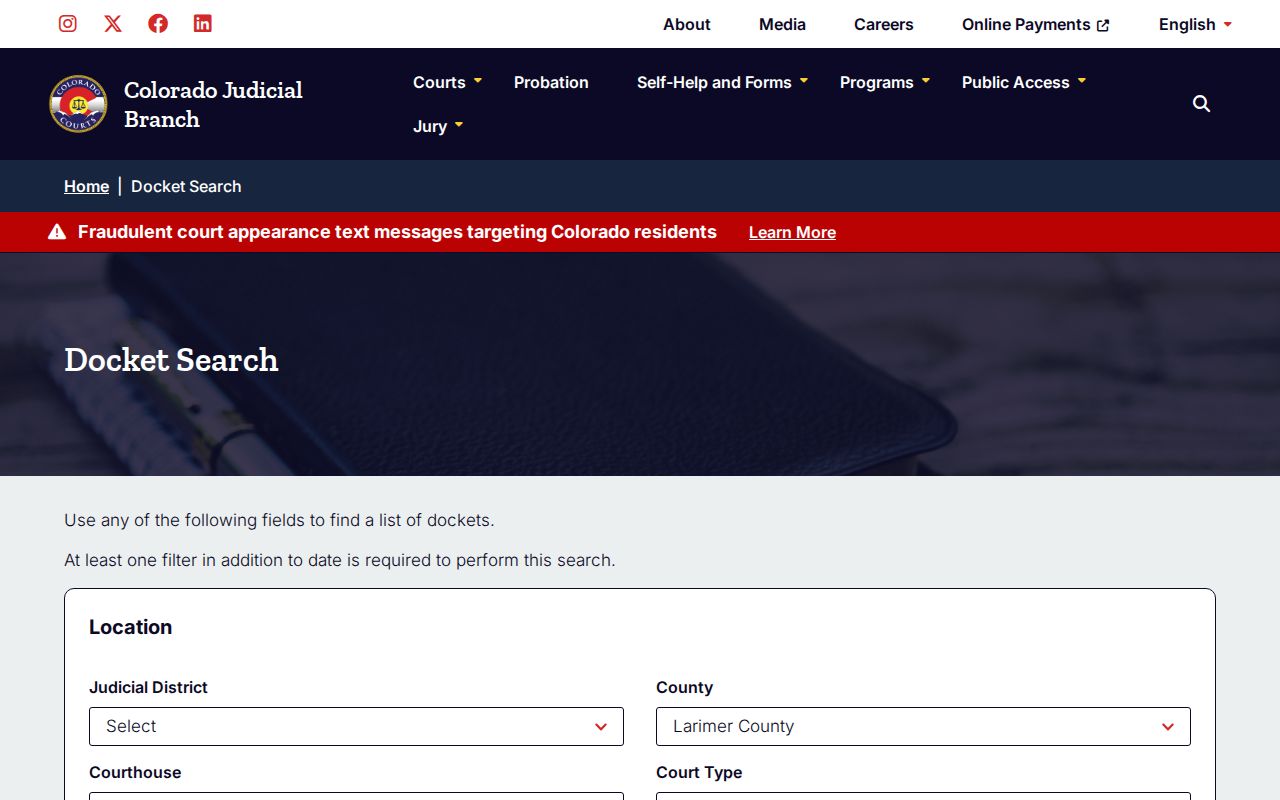
The docket screen shows why a name match needs a case number and a formal record request when verification, not a scheduled event, is the goal. The schedule is only the surface.
Larimer County Business and License Clues
A business or license filing can name a person. But it does not prove a current home address in Larimer County. The Colorado Secretary of State search takes a business name, trademark, trade name, ID or document number. Advanced search adds more. You get filing dates and agent or registrant names. Individual and organization fields, exact-match options, sorting and pagination are also there. An individual trade-name filing is a dated event. It records a true name, business address, trade name, description, filer and a $20 filing amount. DORA’s public verification works differently. It asks for profession, license type, license number, status, last name and first or middle name. A person or facility toggle, or a wildcard asterisk, can broaden a search. Not every occupation is regulated. A license profile is not a resident roster. The Great Colorado Payback search accepts a name, former name, business or former ZIP. But claim proof stays with Treasury. The Colorado Secretary of State business search is the official registry behind a business-linked clue.
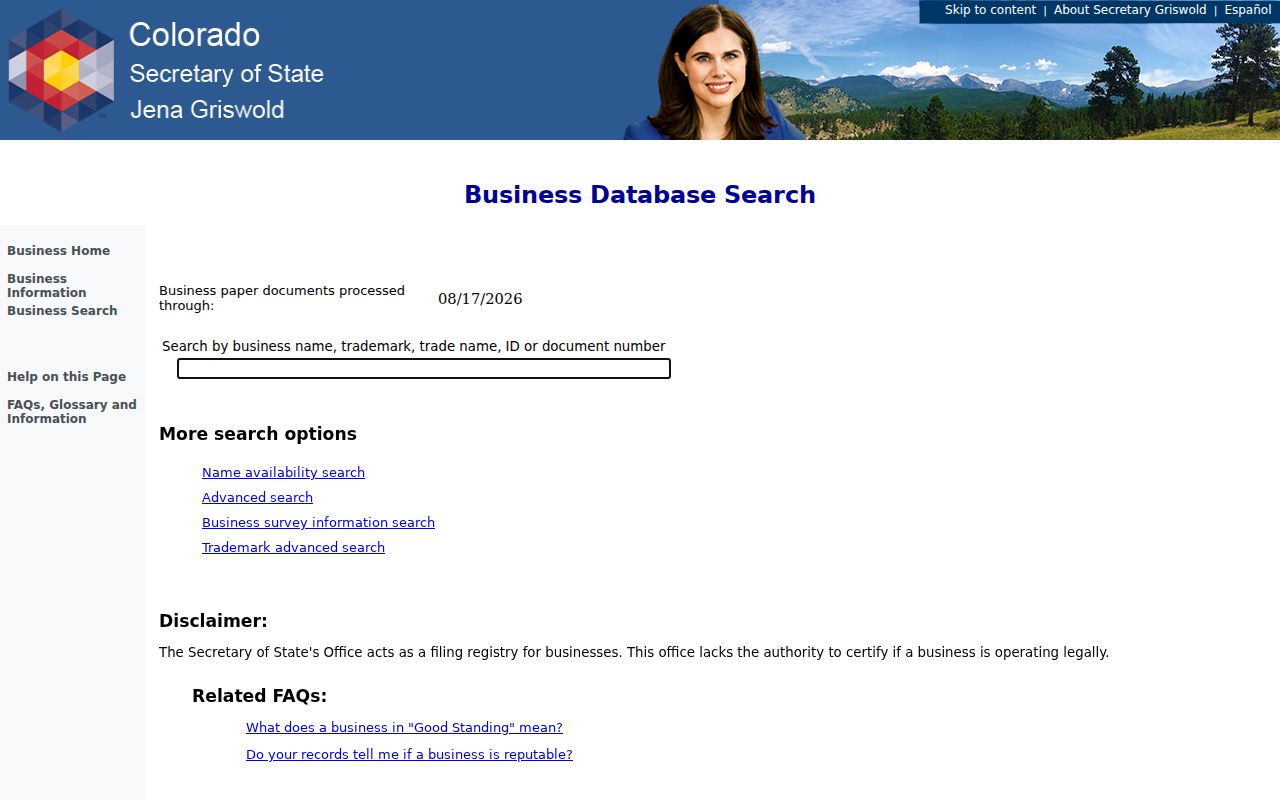
The registry image shows how a filing can connect a name to an organization, not to a place of residence. Meanwhile Colorado license verification is a different public record.
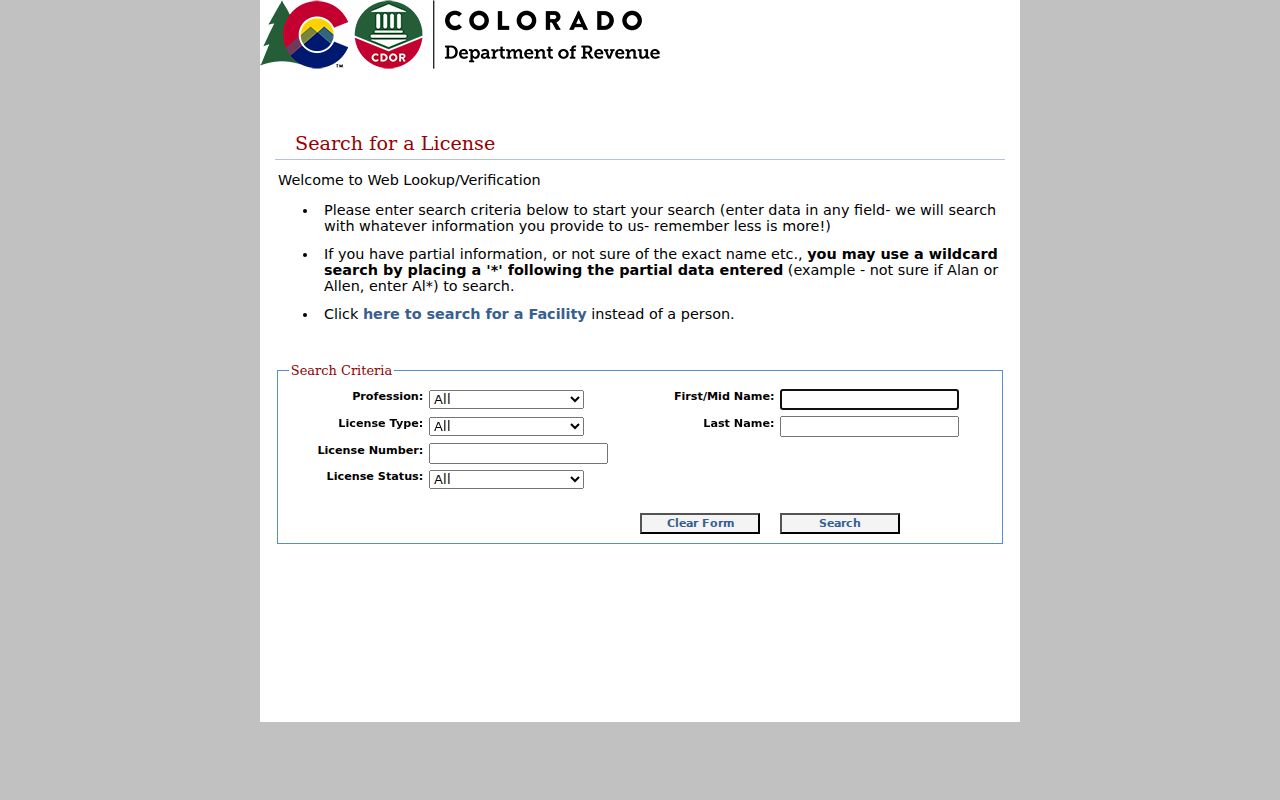
Check the license number, profession and status first. A name match alone means little until those fields line up, and with clear scope a business or license trail can still support civic, family-history or consumer-safety research.
Historical Larimer County Resident Directories
Fort Collins directories open the historical trail. History Connection holds city volumes running from 1902 forward, though gaps exist. Nothing covers 1941 through 1947. Telephone books fill part of that stretch. A typical volume mixes an alphabetical people and business section with a Street Guide, Business Section and Rural Section. Watch the Street Guide. The 1904, 1906 and 1907 books lack one. A failed address search in those years reflects the collection, not proof that nobody lived there.
Loveland's local-history holdings cover most years from 1904. Its directories sit beside newspaper microfilm, vertical files, oral histories, historic maps and Sanborn sheets. Estes Park adds its own material. Town records, photographs, oral histories and newspapers fill out that branch. The county seat also moved from Laporte to Fort Collins in 1868, so an early person or parcel can surface under shifting county-seat and township descriptions. Full collection coverage and the reading method appear on the Larimer County city directories page.
ZIP Geography in a Larimer County Residents Directory
The county ZIP map shows 26 polygons. Two visible pieces make up 80521. Codes 80521, 80524, 80525, 80526 and 80528 offer Fort Collins-area clues without drawing neighborhood lines. Mountain ZIPs such as 80510, 80512, 80515, 80532, 80540 and 80545 need address-level postal checks. Edge codes like 80503, 80504, 80516 and 80612 reach into adjacent-county context. Remember the limit. A ZIP is a delivery clue, not a municipal boundary or a complete Larimer County residents directory.
Match each tool to its job. USPS By Address pins down a precise street. The Assessor's SITUSZIPCODE and MAILZIPCODE fields describe a parcel. Feed the voter lookup a ZIP only as a match input. The Census distinction between ZIP Codes and ZCTAs matters once a map or statistic enters the picture. Document any historical change through USPS or a local notice rather than a guess. The USPS ZIP Lookup returns an address, city/state or cities-by-ZIP result, yet it warns that a result does not guarantee a real or deliverable address.
Law Enforcement and Unclaimed Name Trails
Larimer's Booking Report splits into tabs for inmates, bookings, releases, incident blotter, jail population and transient or homeless bookings. Visible fields range from inmate number, birth date, sex and race to hold reason, arrest date and location, charge, bond and an upcoming court date. The report covers a short, recent window. A no-result is not a historical negative. State DOC custody and the CBI registry carry their own scope, refresh timing, exclusions and identity warnings.
Unclaimed property offers a gentler trail. It suits family history. The Great Colorado Payback search accepts names, former names, businesses and former ZIPs. Treasury handles identity proof for any claim. A hit is a lead, not evidence of a current address. Use the official portal directly. Preserve the result date. The Great Colorado Payback source for Larimer County explains the search and claim route.
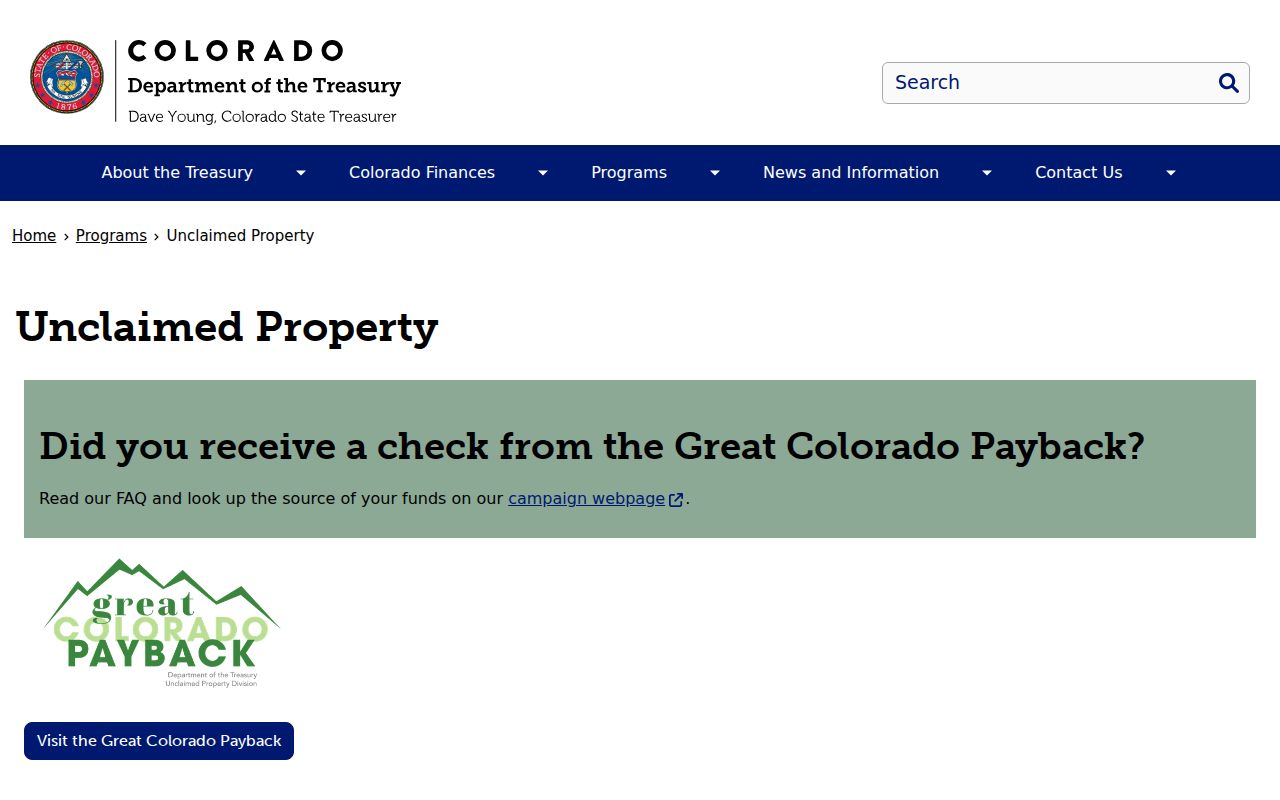
An unclaimed-property hit earns its place in a name-search workflow. It can connect a former name or ZIP to an official claim process without pretending to be a resident index.
Requests When Larimer Portals Stop
Narrow the request before sending it. Colorado Open Records Act procedures ask a requester to identify the custodian, record type, date range, names, addresses and preferred format. Larimer's procedures describe written channels, a three-working-day initial response and a possible seven-day extension. Estimates or deposits can apply. Page, staff and computer fees may follow. Email, fax, mail and hand delivery run through the responsible office.
Match the fallback to the record. Recorder books and copies may require the 200 W Oak counter. Court documents use the Judicial Branch request form. Birth certificates go the county or CDPHE route with ID and eligibility proof. Sheriff requests follow the records process. Library and archive staff can bridge a directory, newspaper or map gap. A phone call confirms coverage, fees, appointments and delivery. It does not replace a written request when the custodian requires one. The Larimer County CORA procedures document is the best starting point for any record the residents directory's linked portals do not expose.
Privacy Protections in Larimer County
Privacy shapes what a Larimer County residents directory can responsibly show. Colorado's Address Confidentiality Program gives qualified survivors a substitute address and mail forwarding. Larimer's voter-record confidentiality form shields the voter-record address for listed eligible categories. A protected voter may drop out of ordinary reports. The Clerk & Recorder also accepts recording redaction requests for certain identity fields. Protected court, vital and law-enforcement material keeps its own rules.
The Colorado Privacy Act grants rights for covered personal data above thresholds. Public government data sits outside that definition. That exclusion matters. It creates no universal deletion right against the Assessor or Recorder. Take correction or suppression questions to the custodian or program. Never combine public fragments into a sensitive profile. Never publish a protected location. Never infer presence from an owner mailing field.
Lawful personal use. Larimer County records support family history, civic research and address verification within the source’s rules. Never use a name, address, court, voter, jail or registry result to stalk, harass, intimidate or harm anyone.
The Colorado Address Confidentiality Program explains the substitute-address route. No public record licenses that hunt.
Recent Larimer County Records Changes
Recent shifts matter for anyone using a Larimer County residents directory. On 16 January 2024, the Clerk & Recorder introduced a free Recording Activity Notification service. It tracks a personal, business, or trust name. When a new county recording appears under that name, the service sends notice. Add any spelling variants for better coverage. Two cautions apply: it only watches new recordings, and it can flag false matches. It does not stop fraud on its own.
Address research has its own wrinkle. Larimer adopted its Road Naming and Site Addressing System Resolution in September 2025. Under that process, a duplicate, similar, or unnamed private drive can be renamed. This happens after public notice and a 45-day suggestion period. Emergency services, the Assessor, and USPS then get notified. Still, USPS may keep delivering under the old address for up to a year. A directory, parcel record, or newspaper from earlier days may therefore carry the outdated number. Keep both labels in mind when comparing records. Before relying on any result, confirm current fees, portal fields, and confidentiality rules. Do this with the named custodian. The Larimer Recording Activity Notification details give the dated background for this service.